
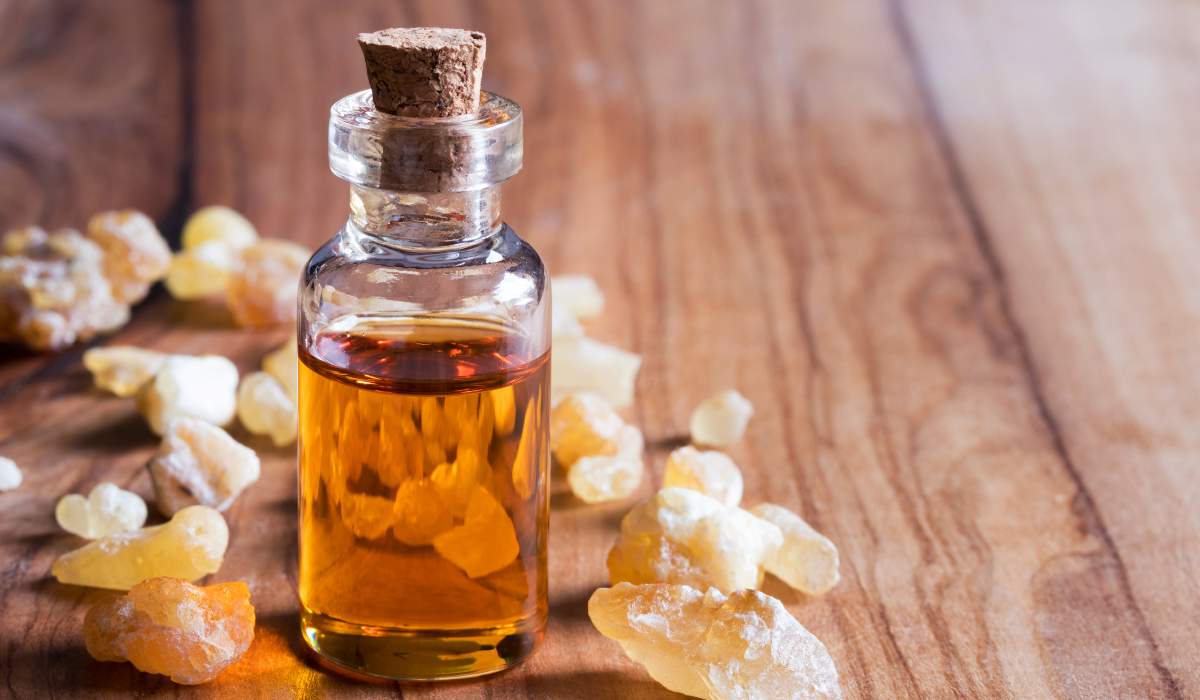
There are no Boswellic Acids in Frankincense Essential Oil
You most probably have been told that frankincense essential oil is anti-inflammatory.
We’re all told the same. I have made the mistake of also repeating this message. People say it with so much certainty: “Frankincense helps with inflammation yadayadayada” and I used to nod along, not realising that actually… it doesn’t.
I’ve been told this everywhere I’ve done my natural ingredients, skincare, etc courses.
Well, I bet you didn’t know either…
Boswellic acids are the ones that take care of the anti-inflammatory benefits. They’re the active compounds that work on your joints as well as autoimmune issues, tumours, etc.
The research is there, quite a bit of it, in fact (below you’ll find lots of research). But it’s all based on the resin or specific extracts of the resin. And NOT the essential oil.
Ouch.
Frankincense in fact can be used in the form of resin, powder, tincture, CO2 extract and, yes, essential oil.
They all come from the same tree, but you need to learn the differences between each. Here they are below.
Resin is the raw, sticky sap collected directly from the frankincense tree. It hardens into golden chunks and has been used for centuries in incense, traditional medicine, and spiritual rituals. You can chew it like gum, burn it for smoke, or grind it into powder.
Powder is just ground-up resin, still whole, still complex, just easier to work with. It’s often used in capsules or teas.
Tincture is a liquid extract made by soaking the resin in alcohol (or sometimes glycerin). This pulls out a broad spectrum of compounds, including the heavier ones like boswellic acids, making it useful for internal use in herbal medicine.
CO2 extract is made using carbon dioxide under pressure to extract a fuller range of constituents, including some of the heavier ones that don’t come through in distillation. It’s closer to the resin than essential oil, often richer and more medicinal.
Essential oil is made by steam-distilling the resin. It captures only the light, volatile aromatic compounds and not the boswellic acids. It is mostly used for scent, mood, and topical applications.
About boswellic acids
Boswellic acids are big. By big I mean chemically big (too big to come through with steam distillation, which is how essential oils are made).
Ah! Yep, basically they don’t “pass through”.
The process of steam distillation involves heating the resin and collecting the light, aromatic compounds that rise with the steam. But, what’s left behind is heavier, which includes the boswellic acids unfortuantely.
So when you buy a bottle of frankincense essential oil, whether it’s carterii, serrata, sacra, or frereana (check my article here on the differences between frankincenses) you’re getting mostly monoterpenes.
Monoterpenes would be things like alpha-pinene, limonene, maybe some sesquiterpenes depending on the species…
These have their own qualities: fresh-smelling, uplifting, sometimes antimicrobial or gently calming. Lovely in their own way, for sure. But they are not anti-inflammatory in the same way boswellic acids are.
Here’s what the acids do:
- Anti-inflammatory effects (studied for arthritis, joint pain, and autoimmune conditions)
- Pain relief (may reduce discomfort linked to chronic inflammation)
- Neurological support (some evidence for use in conditions like multiple sclerosis and memory issues)
- Immune modulation (can help regulate an overactive immune response)
- Anti-tumour potential (early studies show promise in supporting treatment of certain cancers)
- Gut health (may help with inflammatory bowel diseases like Crohn’s or ulcerative colitis)
- Asthma and respiratory relief (traditionally used to ease inflammation in the airways)
So what’s the essential oil good for?
Frankincense essential oil isn’t useless, far from it!! It’s just different.
What it is good for is more emotional, sensory, and skin-deep. It’s calming, grounding, and often used in meditation or prayer because the scent helps people slow down and breathe deeper.
Topically, when properly diluted, it can be soothing for minor skin irritation or dryness. Nothing dramatic, but gentle and supportive.
Some people find it helps them sleep, or that it clears mental fog. It’s not about deep inflammation or internal healing but about presence and ritual.
- Emotional support (calming, grounding, great during meditation or stress)
- Sleep + relaxation (helps quiet the mind and ease tension before bed)
- Respiratory ease (can support deeper breathing when diffused)
- Skincare (may soothe dry or irritated skin when diluted in a carrier oil)
- Mental clarity (some find it helpful for focus or clearing fog)
- Scent + ritual (adds depth and presence to personal care or spiritual practice)
What I think has happened
I think a lot of us end up feeling a bit tricked when we find this out, like we’ve been sold a fantasy. But honestly, I don’t think most people are trying to mislead.
I think this is one of those gaps in understanding that’s just never questioned. People read “frankincense is anti-inflammatory,” assume it applies to the oil, and pass it on. And on. And on.
But once you start looking into it you see the difference. You realise the oil and the resin are NOT interchangeable. If you want the power of the boswellic acids, you’ll need a standardised extract or a resin powder, not a bottle of essential oil.
And personally, I find that kind of clarity comforting. I’d rather know what I’m using, and why, and what it can realistically do.
I still love frankincense essential oil. It smells incredible. It feels grounding. I use it in blends, especially for emotional stuff or in moments where I want to feel a little clearer and more present. I also use it (A LOT) for mature skin care. But if you want the actual anti-inflammatory support, reach for something else.
Check out this article by Dan, all his articles are simpliy amazing:
https://apothecarysgarden.com/blogs/blog/the-many-benefits-of-frankincense-tea-1
The scientific journals
Check the scientific journals below for more information on boswellic acids.
1. Ragab EA, Abd El-Wahab MF, Doghish AS, Salama RM, Eissa N, Darwish SF. The journey of boswellic acids from synthesis to pharmacological activities. Naunyn-Schmiedeberg’s Arch Pharmacol [Internet]. 2024 [cited 2025 Jul 30]; 397(3):1477–504. Available from: https://doi.org/10.1007/s00210-023-02725-w.
2. Usapkar P, Saoji S, Jagtap P, Ayyanar M, Kalaskar M, Gurav N, et al. QbD-guided phospholipid-tagged nanonized boswellic acid naturosomal delivery for effective rheumatoid arthritis treatment. International Journal of Pharmaceutics: X [Internet]. 2024 [cited 2025 Jul 30]; 7:100257. Available from: https://www.sciencedirect.com/science/article/pii/S259015672400029X.
3. Trivedi VL, Soni R, Dhyani P, Sati P, Tejada S, Sureda A, et al. Anti-cancer properties of boswellic acids: mechanism of action as anti-cancerous agent. Front Pharmacol [Internet]. 2023 [cited 2025 Jul 30]; 14. Available from: https://www.frontiersin.org/journals/pharmacology/articles/10.3389/fphar.2023.1187181/full.
4. Hussain H, Wang D, El-Seedi HR, Rashan L, Ahmed I, Abbas M, et al. Therapeutic potential of boswellic acids: an update patent review (2016–2023). Expert Opinion on Therapeutic Patents [Internet]. 2024 [cited 2025 Jul 30]; 34(8):723–32. Available from: https://www.tandfonline.com/doi/full/10.1080/13543776.2024.2369626.
5. Roy NK, Parama D, Banik K, Bordoloi D, Devi AK, Thakur KK, et al. An Update on Pharmacological Potential of Boswellic Acids against Chronic Diseases. Int J Mol Sci [Internet]. 2019 [cited 2025 Jul 30]; 20(17):4101. Available from: https://www.ncbi.nlm.nih.gov/pmc/articles/PMC6747466/.
6. Boswellic Acid – an overview | ScienceDirect Topics [Internet]. [cited 2025 Jul 30]. Available from: https://www.sciencedirect.com/topics/medicine-and-dentistry/boswellic-acid.
7. Ragab EA, Abd El-Wahab MF, Doghish AS, Salama RM, Eissa N, Darwish SF. The journey of boswellic acids from synthesis to pharmacological activities. Naunyn Schmiedebergs Arch Pharmacol [Internet]. 2024 [cited 2025 Jul 30]; 397(3):1477–504. Available from: https://www.ncbi.nlm.nih.gov/pmc/articles/PMC10858840/.
