
Pomegranate Seed Oil Serum For Mature Skin
There’s a particular kind of skin that shows up somewhere in your forties or fifties. It’s not dry, exactly, and it’s not really oily either. It’s just… tired. A bit dull. The bounce it used to have after a good night’s sleep doesn’t quite arrive the way it once did.
If that sounds familiar, pomegranate seed oil deserves a proper look. It’s one of the more interesting carrier oils in natural skincare, not because it’s trendy, but because of what’s actually inside it: a rare compound called punicic acid that most other plant oils simply don’t contain.
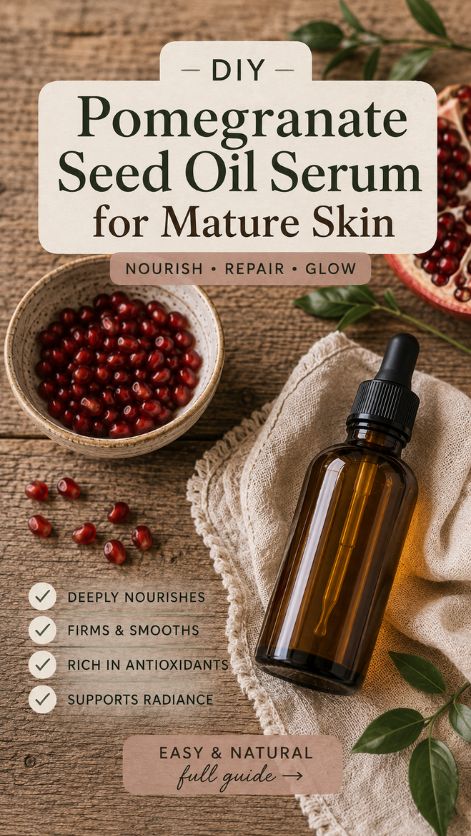
This is a five-ingredient facial serum built around that oil, balanced with jojoba, rosehip, vitamin E and a whisper of frankincense. Nothing complicated, nothing that needs special equipment, and nothing that needs a chemistry degree to understand. Let’s get into why each ingredient earns its place in the bottle.
I’m Patri Hernández, a certified organic skincare formulator and dermocosmetic technician with a background in health coaching. I work with botanical oils and natural formulations regularly, and mature, dehydrated skin is one of the areas I get asked about most.
This post contains affiliate links, which means I may earn a small commission if you buy through one at no extra cost to you. I only recommend products and ingredients I genuinely believe are worth your money.
What makes pomegranate seed oil different from other facial oils
Most carrier oils are made up of fairly ordinary fatty acids. Pomegranate seed oil isn’t. It’s one of the few plant oils rich in punicic acid, a conjugated omega-5 fatty acid that makes up somewhere around 55 to 80 percent of the oil’s fatty acid content, depending on the source and extraction method.
Punicic acid has been studied for its strong antioxidant activity. In laboratory research, it helps neutralise free radicals, the unstable molecules generated by sun exposure, pollution and normal cellular processes that gradually break down collagen and elastin.
A recent study on human skin cells found that pomegranate seed oil showed no toxicity at meaningful concentrations, calmed inflammatory markers, and sped up wound closure in fibroblasts by around 20 percent over 24 hours. That’s laboratory evidence rather than proof of what a home-blended serum will do on your particular face, but it’s a genuinely promising basis for including it in a mature skin formulation.
The oil also contains tocopherols (natural vitamin E) and phytosterols, which support its own stability and give it a naturally rich, slightly thick texture on the skin.
Worth knowing: punicic acid oxidises fairly readily once exposed to light, heat and air, which is exactly why this serum leans on vitamin E and a dark glass bottle for protection. More on that below.
The full ingredient breakdown
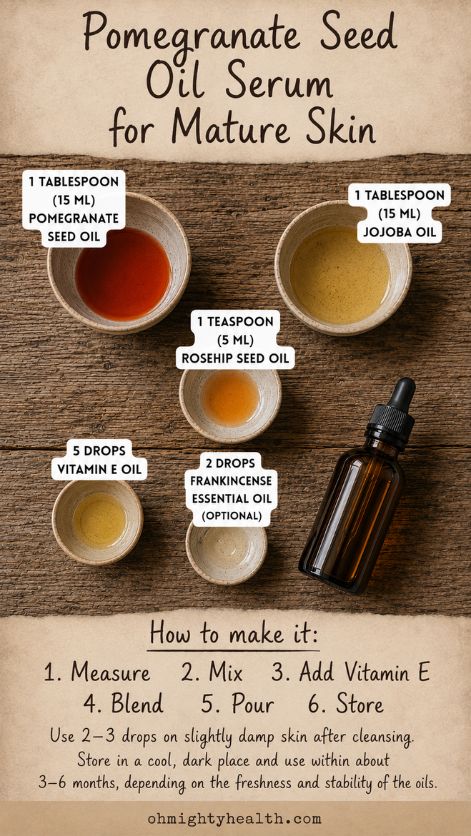
Pomegranate seed oil (1 tablespoon / 15ml)
The star of the blend and your main source of punicic acid and antioxidant polyphenols. It has a naturally deep red colour and a slightly sticky, resin-like texture on its own, which is one reason it’s blended rather than used neat.
Pomegranate seed oil is best sourced cold-pressed, since heat processing degrades some of its antioxidant content.
Jojoba oil (1 tablespoon / 15ml)
Technically jojoba isn’t an oil at all. It’s a liquid wax ester, structurally closer to human sebum than to a typical plant oil. That structural similarity is why it sits so comfortably on the skin without feeling greasy, and why it works across skin types, from oily to very dry.
Research using ex-vivo human skin models found that topically applied jojoba wax increased pro-collagen III and hyaluronic acid production while reducing inflammatory markers. Separate work has shown it accelerates fibroblast migration, one of the key processes in tissue repair.
In this serum, jojoba oil acts as the lightweight carrier that helps the heavier pomegranate and rosehip oils absorb properly instead of sitting on the surface.
Jojoba oil is also one of the more shelf-stable carrier oils available, which helps extend the life of the whole blend.
Rosehip seed oil (1 teaspoon / 5ml)
Rosehip seed oil is one of the more thoroughly researched botanical oils for ageing skin. It’s rich in linoleic and linolenic acids along with natural vitamin C and carotenoids, all of which support the skin’s barrier function.
A double-blind, placebo-controlled human trial found that standardised rose hip supplementation improved skin elasticity, moisture and crow’s feet wrinkle depth over eight weeks. That particular study looked at an oral supplement rather than a topical oil, so it can’t be used as direct proof of what happens when rosehip oil is applied to the face. Separate research on topical rosehip seed oil applied to post-surgical scars did show measurable improvements in skin texture and discolouration, which supports its use on the skin itself.
Rosehip oil has a light, fast-absorbing texture, which is exactly why it appears here in a smaller amount, rounding out the blend rather than dominating it.
Vitamin E oil (5 drops)
Vitamin E isn’t just a skin-conditioning ingredient here. Its main job is protecting the other oils. Punicic acid and the polyunsaturated fatty acids in rosehip oil are both prone to oxidation, and a small amount of vitamin E acts as an antioxidant stabiliser that helps slow that process down, extending the useful life of the finished serum.
Vitamin E oil also has mild moisturising properties of its own, though its role in this formulation is primarily protective.
Frankincense essential oil (2 drops, optional)
Frankincense is included here at a genuinely low dilution: two drops across roughly 35ml of carrier oil works out to well under 1 percent, comfortably inside the 0.5 to 1 percent range generally recommended for facial use.
Research on frankincense essential oil applied to UVB-damaged skin has shown protective effects against oxidative stress and photo-ageing pathways in animal studies. Boswellic acids, the main active compounds in frankincense resin, also have documented anti-inflammatory activity, which is part of why the oil has a long history in skincare specifically for mature or stressed skin.
If you have sensitive skin, are pregnant, or simply prefer to keep things as minimal as possible, this ingredient is genuinely optional. The serum works well without it.
Frankincense essential oil should never be used undiluted directly on skin, but at this ratio within the recipe, it’s already properly diluted.
What you’ll need
- A small glass or stainless steel mixing container
- A digital scale or measuring spoons
- A dark glass dropper bottle, ideally amber or cobalt, around 30 to 60ml in size
- A small funnel (optional, but it saves a mess)
Dark glass matters more than people expect with this particular blend. Punicic acid and the other unsaturated fatty acids here degrade faster under light exposure, so a clear bottle will shorten the serum’s usable life considerably.
How to make it
- Measure your carrier oils. Add 1 tablespoon of pomegranate seed oil, 1 tablespoon of jojoba oil, and 1 teaspoon of rosehip seed oil into your mixing container.
- Mix gently. Stir with a small spoon or glass rod until the oils are visibly combined. There’s no need for vigorous shaking at this stage.
- Add vitamin E. Add 5 drops and stir again. This step protects the finished serum, so don’t skip it even if your batch is small.
- Blend in the frankincense. Add up to 2 drops if using, then stir thoroughly to distribute it evenly through the oil.
- Pour into your bottle. Use a funnel to transfer the finished blend into your dark glass dropper bottle, leaving a little headspace at the top.
- Store properly. Keep the bottle in a cool, dark spot, away from direct sunlight or a steamy bathroom shelf.
That’s genuinely all there is to it. There’s no heating, no emulsifying, and no waiting period before the serum is ready to use, unlike a lot of other DIY skincare projects.
How to use it
Apply 2 to 3 drops to slightly damp skin after cleansing, gently pressing rather than rubbing it in. Damp skin helps the oil spread more evenly and supports better absorption, since facial oils work partly by trapping existing moisture in the skin rather than adding water themselves.
This serum works well layered under a moisturiser, or on its own on nights when your skin doesn’t need anything heavier. Most people find once daily, in the evening, is plenty. Because pomegranate and rosehip oils both contain compounds that can theoretically increase photosensitivity in some formulations, using this serum at night and following up with a proper SPF the next morning is a sensible habit rather than a strict requirement.
Common mistakes to avoid
- Using too much product. More is not better with a concentrated oil blend like this. Two or three drops covers the whole face.
- Skipping the patch test. Frankincense in particular can cause reactions in sensitive individuals, even at low dilution. Patch test on your inner forearm and wait 24 hours before using it on your face.
- Storing it somewhere warm or bright. A windowsill or a steamy bathroom shelf will shorten the shelf life significantly.
- Expecting overnight results. Botanical oils work gradually, supporting the skin barrier and offering antioxidant protection over weeks, not days.
- Applying it to bone-dry skin. You’ll get more from the serum if your skin has a little moisture on it first.
Storage and shelf life
Stored in a dark bottle, somewhere cool and away from direct light, this serum should stay in good condition for roughly three to six months. That range depends on the freshness of your starting oils and how consistently you keep the bottle sealed and out of the light.
Signs your serum has gone off include a noticeably sharper, rancid smell (different from the oils’ natural earthy scent) or a change in colour or texture. If in doubt, trust your nose and make a fresh batch.
For a more complete look at where facial oils fit into a wider skincare routine, my guide to the correct order of skincare products covers exactly when to layer something like this in.
Who should be cautious with this recipe
- Anyone with a known allergy to pomegranate, rose family plants, or frankincense/Boswellia resin
- Pregnant or breastfeeding women, particularly regarding frankincense essential oil, which some sources advise avoiding in the first trimester
- Those with very reactive or eczema-prone skin, who may want to leave out the frankincense entirely and start with a simpler three-oil blend
- Anyone currently using strong retinoids or exfoliating acids, since layering too many active ingredients can increase irritation
As with any new skincare product, if you’re managing a diagnosed skin condition or taking medication, it’s worth a quick check with a dermatologist before adding something new into rotation.
Frequently asked questions
Can I use this serum if I have oily skin?
Jojoba oil in particular tends to be well tolerated by oily and acne-prone skin because of its similarity to sebum, but pomegranate and rosehip are both relatively rich oils. If you have very oily skin, start with a smaller amount and see how your skin responds before using it daily.
Do I have to include the frankincense essential oil?
No. It’s there for its anti-inflammatory and antioxidant properties, but the serum works perfectly well as a three-oil blend without it, and it’s the easiest ingredient to leave out if you have sensitive skin.
Why does the recipe use vitamin E if it’s not the main active ingredient?
Its job here is protective rather than decorative. Without it, the unsaturated fatty acids in the other oils would oxidise more quickly, shortening how long the serum stays fresh and effective.
Can I substitute a different rose or seed oil if I can’t find pomegranate seed oil?
You can, but you’d lose the specific punicic acid content that makes this blend distinctive. If substituting, choose another antioxidant-rich oil such as sea buckthorn, and be aware the properties of the finished serum will shift accordingly.
Is this serum suitable for use around the eyes?
The blend is gentle enough for most people to use carefully around the orbital bone, but avoid getting it too close to the lash line or directly on the eyelid, particularly with the frankincense included.
How is this different from just buying a pomegranate oil product?
Making your own means you control the ratios, the freshness, and exactly what goes in. Commercial versions often dilute the pomegranate oil heavily or add fragrance and preservatives you may not want.
A final thought
There’s something satisfying about a serum this simple. Five ingredients, each one doing a specific job, nothing hiding behind a long list of unpronounceable fillers. It won’t turn back the clock, and anyone promising that from a bottle of plant oil is overselling it, but as a genuinely well-formulated addition to a mature skin routine, it holds up. Give your skin a few weeks of consistent use before judging the results, and keep that bottle out of the sun.
If you’re building out a fuller natural routine around this serum, my guide to natural skin treatments is a good next stop, and if you’d rather simplify everything else you’re using, the simple natural face routine pairs nicely with a serum like this one.
References
- Evaluating pomegranate seed oil for potential topical applications: safety, anti-inflammatory activity and wound healing in skin cell models – Inflammopharmacology
- Punicic Acid: A Potential Nutraceutical Compound in Pomegranate Seed Oil – PMC
- Unveiling the mechanisms for the development of rosehip-based dermatological products: an updated review – PMC
- Topical application of jojoba wax enhances pro-collagen III and hyaluronic acid synthesis in ex-vivo human skin – PMC
- Protective potential of frankincense essential oil against UVB-induced photodamage – PMC
Love, Patri xx
