
Castor oil overnight elbow repair treatment for soft, smooth skin
You know the moment. You go to rest your arms on a table, or you catch sight of your elbows in a mirror, and there they are: dry, scaly, a bit grey-looking, sometimes even cracked at the edges. Elbows are one of those spots we forget about entirely until they demand our attention, usually right before we need to wear something short-sleeved.
The good news is that rough elbows are one of the easiest skin concerns to fix at home, and you probably already have most of what you need sitting in your kitchen cupboard or bathroom cabinet. This overnight treatment pairs aloe vera gel with castor oil, and while it looks almost too simple to work, there’s genuinely sound reasoning behind why this particular combination gets results.
I’m Patri Hernández, a certified organic skincare formulator and dermocosmetic technician with a background in health coaching. I specialise in natural skincare, botanical ingredients, and practical, evidence-informed approaches to skin health, which is exactly the lens I want to bring to something as unglamorous but genuinely bothersome as rough elbows.
This post may contain affiliate links. If you make a purchase through one of these links, I may earn a small commission at no extra cost to you. I only recommend products I genuinely think are worth your money.
Why elbows get so rough in the first place
Elbow skin isn’t like the skin anywhere else on your body, and that’s the root of the problem.
The skin over your elbow joint has very few oil glands compared to your face or torso. Oil glands are what keep skin naturally lubricated, so an area with fewer of them is already starting from a disadvantage when it comes to staying soft.
On top of that, your elbows bend constantly. Every time you lean on a desk, fold your arms, or rest your chin on your hand, that skin gets compressed and stretched. Repeated friction and pressure trigger the skin to thicken as a protective response, which is why elbows often develop that leathery, slightly darker patch that feels tougher than the skin around it.
Add in central heating, hot showers, low humidity, and the fact that most body lotions get applied everywhere except the elbows, and you’ve got the perfect storm for permanently rough patches.
Common triggers worth knowing about
- Hot showers and baths, which strip natural oils faster than warm water
- Leaning on hard surfaces regularly (desks, tables, armrests)
- Cold or dry air, indoors or out
- Ageing skin, which produces less natural oil over time
- Certain underlying conditions such as hypothyroidism or eczema, which can make rough patches more stubborn
If your elbows are cracked, bleeding, intensely itchy, or not improving after a few weeks of consistent care, it’s worth having them looked at by a dermatologist rather than relying on home treatment alone.
Why this combination works: aloe vera and castor oil
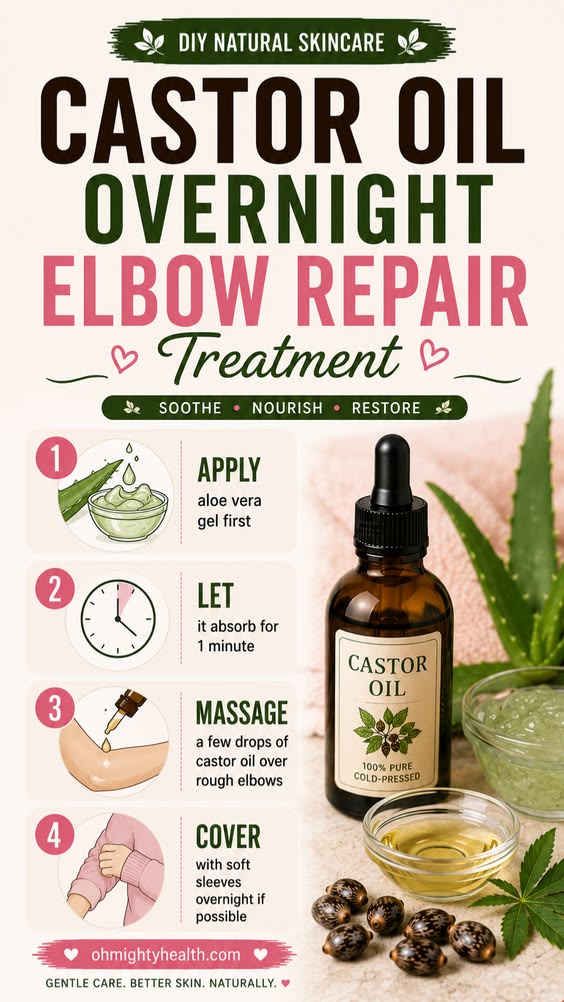
The pin shows a four-step process, and each step has a real purpose. This isn’t just “slap oil on it and hope for the best.” Let’s break down why the order matters.
Aloe vera gel first: hydration before oil
Aloe vera gel is mostly water, along with polysaccharides that have a humectant effect, meaning they help draw moisture into the outer layer of skin. Applying it first hydrates the skin cells before you seal them with oil.
This order matters more than people realise. Oils are occlusives, not hydrators. An occlusive forms a barrier on top of the skin that slows down water loss, but it doesn’t add water of its own. If you apply oil to completely dry skin with nothing underneath it, you’re essentially sealing in dryness rather than moisture.
Applying aloe vera gel first gives the skin something worth locking in.
Letting it absorb for a minute
This pause matters more than it looks. Aloe vera gel needs a little time to be absorbed into the skin before you layer oil on top. If you go straight in with oil while the gel is still sitting on the surface, you risk the two products pooling together and sliding off rather than actually doing their job.
A full minute is a sensible waiting period, giving the aloe time to sink in without you having to stand around for ages.
Massaging in the castor oil
Castor oil is thick, rich in ricinoleic acid, and genuinely excellent at forming a protective, moisture-sealing film on the skin. It’s one of the most viscous carrier oils used in skincare, which is part of why it feels so heavy and coating compared with something lighter like grapeseed or jojoba oil.
That heaviness is actually an advantage for elbows specifically. Thin, fast-absorbing oils tend to disappear before they’ve had a chance to properly soften thick, callused skin. Castor oil sits on the surface longer, giving it more time to do the job.
Massaging it in, rather than just dabbing it on, also has a practical benefit: the friction and warmth from massage can help gently soften the outer, thickened layer of skin, making it easier for the oil to penetrate.
You’ll want a good quality cold-pressed castor oil for this. If you’re dealing with particularly stubborn, thickened elbow skin, Jamaican black castor oil is worth considering too. It goes through a roasting process before pressing, which some people find gives it an even richer, more emollient feel, though the two work in a broadly similar way.
Covering with sleeves overnight
This final step is what turns a nice moment of self-care into an actual overnight treatment. Covering the area, whether with a soft long-sleeved top or even a loose bandage, creates what’s called occlusion.
Occlusion traps both the product and your skin’s own moisture against the surface, dramatically boosting how much hydration actually gets absorbed compared with leaving skin exposed to the air. It’s the same principle behind slugging in facial skincare, just applied to a much tougher, more neglected part of the body.
If you don’t fancy sleeping in sleeves, an old cotton sock with the toe cut off, or a loose gauze wrap, works just as well.
How to do the full treatment, step by step
What you’ll need
- Pure aloe vera gel (ideally 99–100% aloe with minimal added ingredients)
- Cold-pressed castor oil, or Jamaican black castor oil for extra-tough patches
- Soft, loose sleeves, a cotton sock, or a gauze wrap
- A warm, damp cloth (optional, for exfoliation beforehand)
Step-by-step instructions
- Prep the skin (optional but recommended). Gently wipe the elbows with a warm, damp cloth for 30 seconds. This softens the surface and helps the aloe absorb better. Avoid scrubbing hard, especially if the skin is already cracked.
- Apply aloe vera gel. Use a generous, even layer over both elbows.
- Let it absorb for about a minute. Use this time to get comfortable, brush your teeth, or do whatever else is part of your evening routine.
- Massage in a few drops of castor oil. Warm the oil between your fingers first, then work it into the elbow using small circular motions for 30 to 60 seconds per side.
- Cover with soft sleeves overnight. A loose, breathable fabric works best. Avoid anything tight that could restrict circulation while you sleep.
- Rinse or wipe off in the morning if there’s any residue left, though most of it should have absorbed overnight.
How often should you do this?
For genuinely rough, neglected elbows, doing this treatment nightly for the first week tends to produce a noticeable difference. After that, two to three times a week is usually enough to maintain soft skin, with a daily lighter moisturiser in between if you like.
There’s no need to do this every single night indefinitely. Skin that’s already well hydrated doesn’t need the same intensity of occlusive treatment, and overdoing rich oils on skin that doesn’t need it can occasionally lead to congestion in people who are prone to body acne or folliculitis around the upper arms.
Common mistakes that slow down results
- Skipping the aloe vera step. Oil alone on very dry skin seals in dryness rather than fixing it.
- Not exfoliating occasionally. Rough elbows often have a build-up of dead, thickened skin cells. A gentle scrub with sugar and a little carrier oil once a week, before your treatment, helps products penetrate rather than just sitting on top.
- Using too little oil. Elbow skin is thick and needs a generous amount, not just a token drop.
- Expecting overnight miracles after one use. Deeply thickened, calloused elbow skin took a while to build up, and it takes consistent care over a couple of weeks to properly soften.
- Choosing a heavily fragranced or diluted aloe gel. Some shop-bought gels contain a high percentage of alcohol or added fragrance, which can be drying or irritating on already compromised skin. Look for a simple, minimally processed gel.
Safety notes and who should be cautious
Castor oil and aloe vera are both generally well tolerated, but a few sensible precautions are worth mentioning.
- Patch test first. Apply a small amount of castor oil to the inside of your forearm and wait 24 hours before using it on a larger area, particularly if you have sensitive skin or known allergies to plants in the Euphorbiaceae family.
- Aloe vera can occasionally cause contact dermatitis in people sensitive to it, especially if the gel is not pure. Check for redness or itching after first use.
- Avoid open cracks or broken skin when applying either product until the skin barrier has had a chance to start healing, as this can sting and increase the risk of irritation.
- If you’re pregnant, note that castor oil is sometimes associated with uterine stimulation when taken orally in large quantities. This is not a concern with the small topical amounts used here, but it’s worth mentioning so you have the full picture.
Storage tips
Keep both products in a cool, dark cupboard rather than a steamy bathroom shelf, as heat and humidity shorten shelf life. Aloe vera gel, especially if it’s a natural product without heavy preservatives, is best kept refrigerated once opened and used within a few weeks. Castor oil is far more shelf-stable and, stored properly away from light and heat, will typically keep well for a year or more.
Frequently asked questions
Can I use this treatment on other rough patches, like knees or heels?
Yes. The same principle of hydrate-then-seal works well anywhere skin tends to thicken and dry out, including knees, heels, and cuticles.
Do I need to use pure castor oil, or can I use a blend?
Pure, cold-pressed castor oil is ideal for this treatment because of its thickness and occlusive quality. Blends diluted with lighter oils will absorb faster but won’t create the same overnight sealing effect.
Will this lighten dark elbow skin?
Darkening around the elbows is usually a result of skin thickening (hyperkeratosis) and friction rather than pigmentation alone, though pigmentation can play a role too. Consistently softening and exfoliating the area tends to improve the appearance over time, but if pigmentation is the main concern, that’s a separate issue worth discussing with a dermatologist.
What if my elbows still feel rough after two weeks?
If there’s no improvement at all after consistent nightly use for two weeks, there may be an underlying issue such as keratosis pilaris, eczema, or a thyroid-related dryness that’s worth having assessed properly rather than treated at home indefinitely.
Can I use this in the morning instead of overnight?
You can, though you’ll lose the benefit of the occlusion step. If using it during the day, apply a thinner layer of oil and allow a few extra minutes for it to absorb before getting dressed.
Rough elbows are such a small, unglamorous thing to think about, but they respond really well to a bit of consistent, deliberate care. Once you’ve got the hydrate-then-seal habit down, you can apply the same logic to knees, heels, or any other patch of skin that tends to get neglected. It’s a genuinely simple routine, and the results are usually worth the tiny bit of effort it takes.
Love, Patri xx
