
Cardamom hair ends oil for dry tips: a simple fix for brittle, damaged ends
I’m Patri Hernández, a certified organic skincare formulator and dermocosmetic technician with a background in health coaching. I work closely with botanical oils and natural formulations, including how they can be adapted to support hair health, not just skin.
A quick note before we start: some of the links in this post are affiliate links, which means I may earn a small commission if you buy through them, at no extra cost to you. I only recommend products I genuinely think are worth your money.
If you’ve ever run your fingers through your hair and felt that rough, straw-like texture right at the ends, you already know how frustrating dry, damaged tips can be. No amount of conditioner seems to fix it properly, and by the time you notice the dryness, the damage is often already done.
That’s exactly the problem a simple hair ends oil is designed to solve. Unlike a full hair mask or a heavy scalp treatment, a hair ends oil is a lightweight, targeted fix. You’re not trying to change how your hair grows or treat your scalp. You’re simply protecting and smoothing the most fragile, oldest part of your hair strand: the ends.
The blend below combines argan oil, broccoli seed oil, and a touch of cardamom essential oil. Let’s go through why each ingredient earns its place, and how to use the blend properly so you get real benefit from it, not just a nice smell.
Why this matters: understanding dry, damaged ends
Hair ends are the oldest part of each strand. They’ve been exposed to years of brushing, heat styling, sun, and washing, so naturally, they’re the most fragile and prone to dryness and split ends.
Unlike your scalp, which produces natural oils (sebum) to keep hair near the roots conditioned, that sebum rarely travels all the way down to the tips, especially if your hair is long, curly, or coloured. That’s why the ends often feel dry even when your scalp feels perfectly balanced, sometimes even oily.
What you’ll need
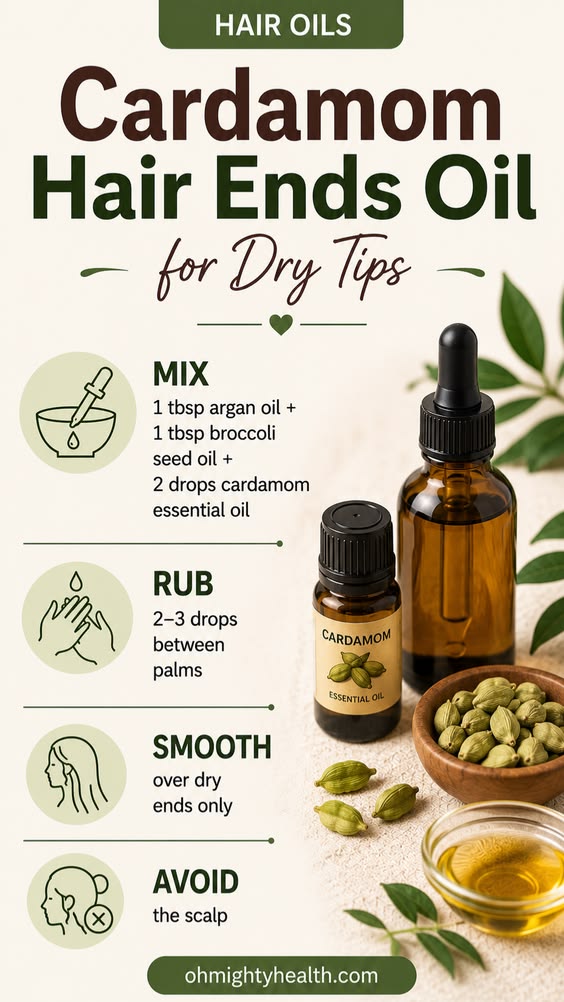
- 1 tablespoon argan oil
- 1 tablespoon broccoli seed oil
- 2 drops cardamom essential oil
- A small glass dropper bottle or a small mixing bowl
Why these ingredients specifically
- Argan oil is rich in fatty acids and vitamin E, and it’s one of the most well-studied natural oils for hair. It coats the hair shaft, helping reduce moisture loss and giving strands a smoother, glossier appearance. If you want a reliable one to start with, I like this organic argan oil.
- Broccoli seed oil is a less familiar ingredient, but it has a reputation in natural haircare circles as a “silicone alternative.” It’s high in erucic acid, which gives hair a similar glassy, smooth finish to silicone-based products, but without building up on the strand over time the way silicones can.
- Cardamom essential oil is included here mostly for its warm, comforting scent, and traditionally it’s been associated with scalp and hair wellness in some cultures. I want to be honest with you here: there isn’t strong scientific research specifically proving cardamom oil improves hair health. Its role in this blend is complementary rather than the active ingredient doing the heavy lifting.
How to make it
- Measure the argan oil and broccoli seed oil into your dropper bottle or small bowl.
- Add the cardamom essential oil.
- Gently swirl or shake to combine. There’s no need for heat or special equipment.
- Label your bottle with the date you made it, so you know when to use it by.
How to use it
- Warm 2 to 3 drops of the oil between your palms.
- Rub your palms together so the oil is evenly distributed and slightly warmed.
- Smooth your hands over the dry ends of your hair only, working from mid-length downwards.
- Avoid the scalp and roots.
That last point matters more than it might seem. Applying oil near your roots can weigh hair down and make it look greasy quickly, especially if you have fine or oily hair. Keeping the oil confined to the ends is what makes this method work so well without leaving your hair looking heavy.
When to use it
You can apply this oil to damp hair after washing, before styling, or to dry hair whenever your ends feel rough or look frizzy. It’s not a rinse-out treatment, so there’s no need to wash it out afterwards.
Common mistakes to avoid
- Using too much oil at once. Two or three drops is genuinely enough for most hair lengths; you can always add a touch more.
- Applying it to unwashed roots, which can make hair look oily rather than sleek.
- Skipping the patch test if you have sensitive skin, particularly because of the essential oil.
Safety considerations
Cardamom essential oil is potent and should never be applied undiluted directly to skin or scalp. In this recipe, it’s already diluted within the carrier oils, which is the correct approach. Still, if you have particularly sensitive skin or a history of allergic reactions to essential oils, do a small patch test on your inner arm 24 hours before applying the blend to your hair.
If you’re pregnant, breastfeeding, or on any medication, it’s worth checking with your doctor before introducing a new essential oil into your routine, even for topical, hair-only use.
Storage and shelf life
Store your finished oil blend in a cool, dark spot, away from direct sunlight and heat. A bathroom cabinet works better than a windowsill.
Carrier oils like argan and broccoli seed oil can oxidise over time, so I’d recommend using this blend within two to three months for the best results. If it starts to smell different or “off” compared to when you made it, it’s time for a fresh batch.
Frequently asked questions
Can I use this oil on my scalp too?
It’s best kept to the ends. If you want a scalp-focused oil, that’s really a separate blend with different goals and ingredients.
Will this help my hair grow faster?
Not directly. This blend is about protecting and smoothing existing hair, not stimulating growth. If growth is your main concern, that’s a different conversation with different ingredients.
Can I substitute the oils?
Yes, to an extent. If you don’t have broccoli seed oil, jojoba oil is a reasonable substitute, as it’s also lightweight and closely mimics your hair’s natural sebum.
Dry ends aren’t something you fix overnight, but a simple, consistent habit like this one can make a real difference to how your hair feels and looks day to day. Give it a few weeks of regular use before judging the results, and remember that trims are still important; oil can smooth existing damage, but it can’t repair a split end that’s already happened.
Love, Patri xx
