
How to put castor oil in your hair without it turning greasy
If you’ve ever tipped castor oil onto your scalp with good intentions and ended up with a head that looks like you’ve been caught in a chip fryer, you’re not alone. It’s one of the most common complaints I hear about this oil, and it’s completely understandable, because castor oil is genuinely one of the thickest, stickiest oils in the carrier oil world.
That thickness is exactly why it works so well as a conditioning treatment. It’s also exactly why so many people give up on it after one greasy, weighed-down attempt.
The good news is that the greasiness isn’t really castor oil’s fault. It’s almost always down to how much is used, where it’s applied, and how it’s rinsed out. Get those three things right and you can enjoy the benefits without the oil slick.
I’m Patri Hernández, a certified organic skincare formulator and dermocosmetic technician with a background in health coaching. I specialise in natural skincare, botanical ingredients and evidence-informed approaches to hair and scalp care, so I’ve spent a lot of time working out why certain oils behave the way they do on hair and skin.
This post contains some affiliate links, which means I may earn a small commission if you make a purchase through one, at no extra cost to you. I only recommend products I genuinely think are worth your money.
Why castor oil turns greasy so easily
Castor oil has a much higher viscosity than most other carrier oils. Where something like jojoba or grapeseed oil feels light and almost silky, castor oil is thick, syrupy and slow to spread.
That density comes largely from ricinoleic acid, an unusual fatty acid that makes up the vast majority of castor oil’s fatty acid profile. It’s what gives the oil its reputed conditioning and scalp-soothing qualities, but it’s also what makes it cling stubbornly to hair strands rather than absorbing quickly.
Add too much of it, apply it in the wrong place, or skip a proper rinse, and it simply sits on the surface of your hair looking for a way to make your roots shine for all the wrong reasons.
What you’ll need
- Castor oil or, if you’re focusing on the scalp specifically, Jamaican black castor oil, which is slightly less viscous and easier to work with
- A lighter carrier oil to dilute it, such as jojoba oil or argan oil
- A wide-tooth comb or an old toothbrush for precise, sparing application
- A shower cap or old towel, if you’re leaving it in overnight
- A gentle, thoroughly cleansing shampoo
Step-by-step: how to apply castor oil without the greasy aftermath
1. Dilute it first
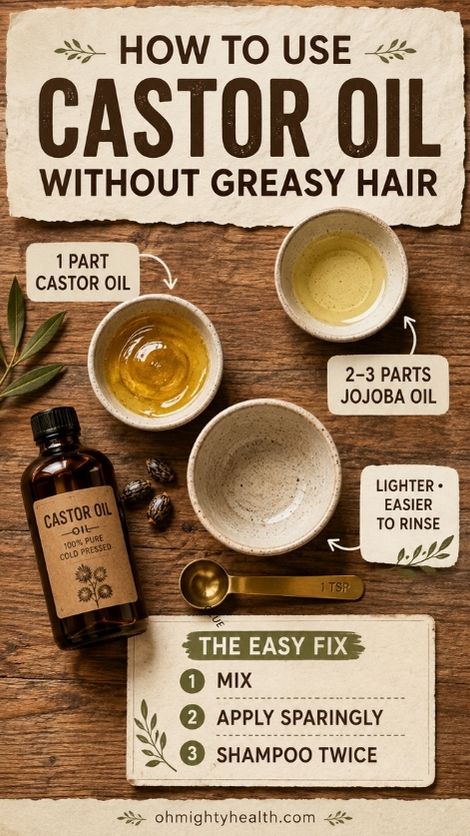
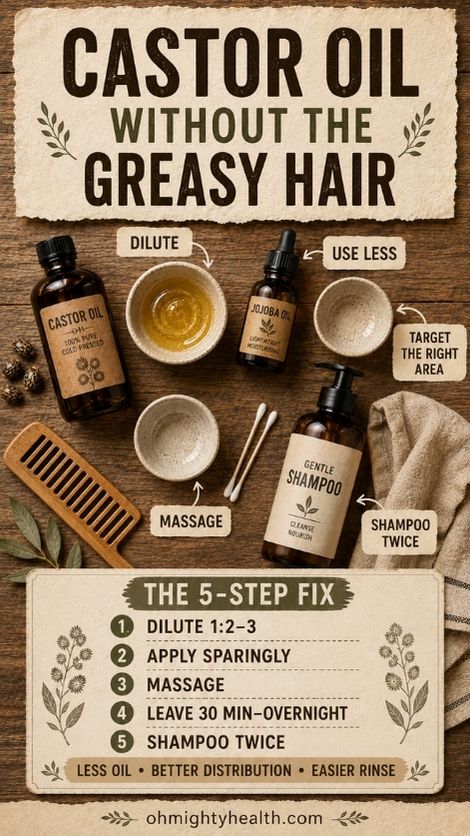
This is the single biggest fix, and the one most people skip. Castor oil rarely needs to be used neat. Mixing it with a lighter oil, at roughly one part castor oil to two or three parts jojoba or argan oil, keeps its conditioning properties while making it far easier to distribute evenly and rinse out fully.
2. Use less than you think you need
A little genuinely goes a long way here. For most hair lengths, a teaspoon of the diluted oil blend is plenty for the scalp, with perhaps another teaspoon for the lengths and ends if they’re dry. Doubling this “just in case” is the fastest route to a greasy result.
3. Be deliberate about where it goes
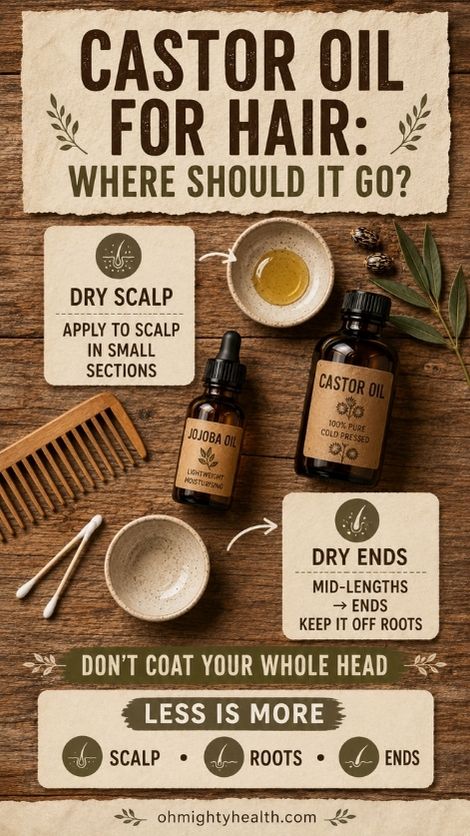
If your main concern is scalp health or hair growth, the oil should go on the scalp, applied in small sections with a toothbrush, cotton bud, or your fingertips, rather than raked through the entire length of your hair.
If you’re targeting dry, frizzy ends instead, keep the oil away from your roots altogether and focus it from mid-length downwards. Trying to condition your whole head with the same amount of product is where most of the greasiness complaints come from.
4. Warm it slightly
Castor oil thins out and spreads more evenly when it’s slightly warm. Standing the bottle in a bowl of warm water for a few minutes, or rubbing a small amount between your palms before applying, makes a noticeable difference to how far it goes and how well it distributes.
5. Massage it in properly
Once applied, spend a couple of minutes massaging the oil into the scalp with your fingertips. This isn’t just pleasant, it also helps break the oil down and spread it more thinly across the skin rather than leaving it pooled in one spot.
6. Give it time to work
Castor oil is typically left on for anywhere between thirty minutes and overnight, depending on how much time you have and how your scalp tolerates it. If you’re leaving it in overnight, protect your pillow with an old towel or wear a shower cap, both to save your bedding and to help gently warm the oil so it continues to penetrate.
7. Rinse thoroughly, and expect to shampoo twice
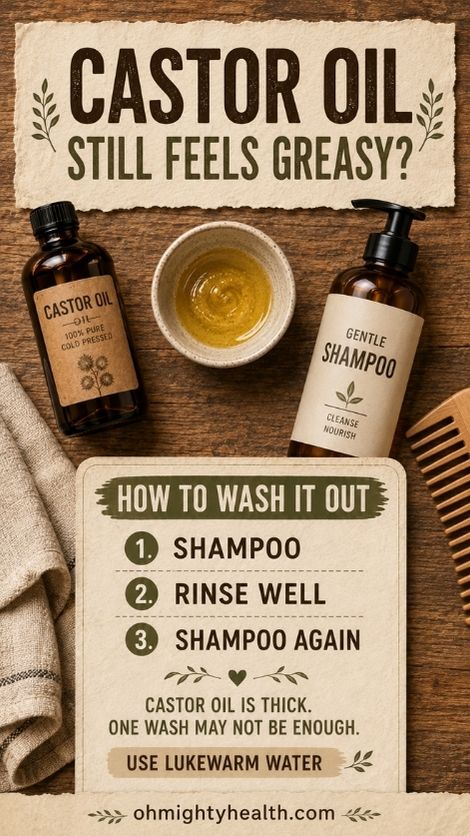
This is where a lot of the “castor oil made my hair greasy for days” complaints actually originate. Because castor oil is so thick, one shampoo often isn’t enough to remove it fully, particularly at the roots.
Shampoo, rinse completely, then repeat. Use lukewarm rather than hot water, as very hot water can make oil harder to emulsify properly. If your hair still feels coated after two washes, a clarifying shampoo used occasionally can help remove any lingering residue without over-stripping your scalp.
Common mistakes that make castor oil greasier
- Using it neat and undiluted, especially on fine or already oily hair
- Applying too much, on the assumption that more product means more benefit
- Covering the entire scalp and lengths when only one area actually needed treating
- Rinsing with a single shampoo wash instead of two
- Skipping the massage step, which leaves the oil sitting in concentrated pools rather than spread thinly
Who might want to be cautious
Castor oil is generally well tolerated, but it’s worth being sensible about it.
- If you have very fine, low-porosity hair, even a diluted castor oil treatment can feel heavy. Consider using it less frequently, or swapping in a lighter oil such as jojoba for regular conditioning and saving castor oil for occasional deeper treatments.
- If you have an existing scalp condition, sensitivity, or a known allergy to castor oil or any of its components, do a small patch test on your inner arm before applying it to your scalp.
- Some traditional claims around castor oil and dramatic hair growth are not strongly supported by robust clinical research. The evidence for ricinoleic acid’s anti-inflammatory and scalp-soothing properties is more established, so it’s fair to think of castor oil as a supportive conditioning treatment rather than a guaranteed growth solution.
How often to use castor oil on your hair
Once or twice a week is a sensible starting point for most hair types. Because it’s so rich, more frequent use rarely adds extra benefit and simply increases the chance of build-up, especially if you’re not rinsing thoroughly each time.
If you have a very dry scalp or particularly coarse hair, you may find you can tolerate it slightly more often. If your hair feels heavy or your scalp starts to look shiny between washes, that’s your sign to scale back.
Frequently asked questions
Can I leave castor oil in my hair without washing it out?
You can, but only if you’ve used a very small, diluted amount focused on the ends rather than the scalp. Left-in castor oil on the roots will almost always look greasy by the next day.
Why does my hair still feel greasy after washing out castor oil?
This usually means either too much oil was applied, or a single shampoo wasn’t enough to break down and remove it. Try double shampooing, and consider diluting the oil more heavily next time.
Should I apply castor oil to wet or dry hair?
Dry hair and a dry scalp generally allow the oil to be applied more precisely and absorb more effectively than wet hair, where water can interfere with even distribution.
Does diluting castor oil reduce its benefits?
No. Diluting simply makes the oil easier to apply evenly and rinse out. The active components, including ricinoleic acid, are still present, just in a more manageable, spreadable form.
Once you’ve adjusted how much you’re using and where you’re putting it, castor oil stops being the sticky, unpredictable ingredient it’s often accused of being and starts doing what it does best: quietly conditioning your scalp and ends without leaving evidence behind. For more ways to support hair health naturally, take a look at our guide to natural remedies for thicker, fuller hair and our simple natural hair growth tips.
Love, Patri xx
