
One Bottle, 20 Gifts: Easy Castor Oil Gift Ideas People Actually Use
Quick question.
How many people on your gift list are impossible to buy for?
Dad. Your sister-in-law. The neighbour who already has everything. The teacher you’d like to thank without spending a small fortune.
Here’s the thing: you can sort most of them with one bottle of castor oil.
I know. It isn’t the most glamorous ingredient in the cupboard. It’s thick, it’s sticky, and most people only think of it as an old-fashioned remedy.
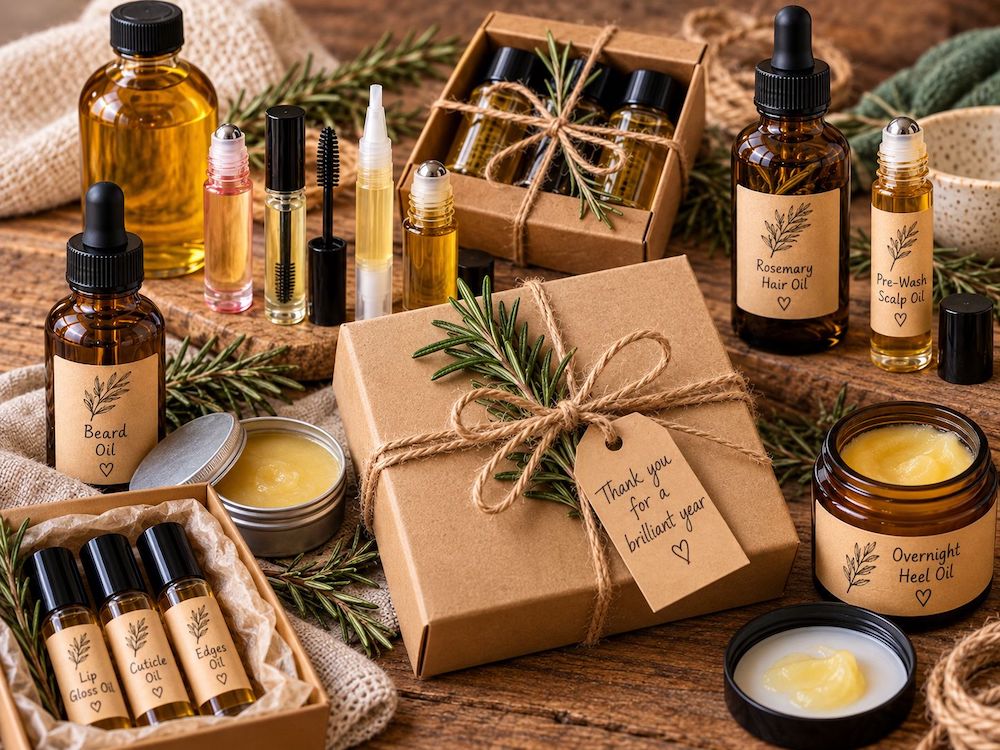
But a litre fills roughly 90 small 10 ml bottles. Mix it with a lighter oil and that one bottle becomes lip oil, beard oil, heel oil, a cuticle pen and a whole shelf of gifts that look far more expensive than they are.
Below you’ll find 20 castor oil gift ideas, grouped by who they’re for. Each one comes with the base oil, the right bottle, a label name and exact amounts in both ml and teaspoons, so it works wherever you live.
I’m Patri Hernández, a certified organic skincare formulator and dermocosmetic technician with a background in health coaching. I specialise in natural skincare, botanical ingredients, essential oils and practical, evidence-informed approaches to wellness, which is why this guide is as much about what not to do as what to do.
Some links here are affiliate links, so I may earn a small commission if you buy through them, at no extra cost to you. That never changes what I recommend, and I only point you to things I believe are genuinely useful.
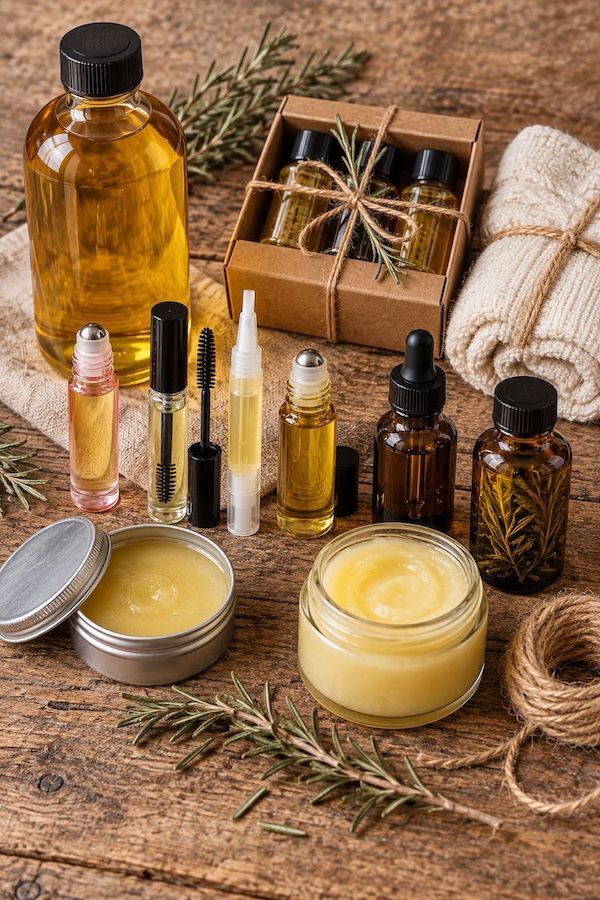
What one bottle of castor oil does for your gift list
Here’s what you actually get out of this guide:
- One shopping trip, not twenty. Castor oil, one or two lighter oils and a handful of bottles cover every idea below.
- Around 90 mini gifts from a litre. Once you own the bottle, the oil costs very little per gift. Most of the spend goes on the small bottle and the label.
- The hard-to-buy people, sorted. Him, coworkers, teachers, neighbours and the friend who says “don’t get me anything” each have a gift in here.
- No sticky disasters. The right ratios and the right bottles mean the person you give it to enjoys using it, instead of wrestling a clogged dropper.
- Safer gifts. Patch test wording, label wording and eye-area cautions are built in, so what you hand over is lovely and responsible.
- A gift that suits the season. Lips, hands and heels need the most care when it turns cold, so these get used. My winter skincare routine shows where they fit.
- Easy to batch. Line up the bottles, fill ten in one sitting and label them last.
In a hurry? Make the lip oil (idea 2), the cuticle oil pen (idea 4) and a trio of mini bottles (idea 13). That’s a gift, a stocking filler and a thank-you in one go.
Why castor oil works as a gift
Castor oil is cheap, easy to find and familiar, so people recognise it. It’s also unusual: roughly 90% of its fatty acid content is ricinoleic acid, which gives it that thick, glossy, clingy feel.
That texture is why it works so well in lip oils and conditioning treatments. It’s also why it needs careful handling.
This is where the evidence matters, so here is where things stand:
- Well supported: castor oil is a recognised cosmetic ingredient. The Cosmetic Ingredient Review panel concluded it is not a significant skin irritant, sensitiser or photosensitiser in human tests, although people with certain occupational skin conditions can react.
- Early-stage: ricinoleic acid has shown anti-inflammatory activity in animal studies. That is laboratory work, not proof of what a bottle of homemade oil will do for the person you’re gifting it to.
- Not well supported: claims that castor oil grows hair, lashes or brows. I’m not aware of robust human trials showing it does, so every gift here is described as conditioning and nourishing, and that’s all.
Plenty of bloggers and content creators repeat the growth claims because they sell, and most haven’t checked the science. I’d rather you gave something honest.
Did you know? Ancient Egyptians burned castor oil in their lamps. The Swansea Egypt Centre notes it seems to have been the most common lamp oil. The Ebers Papyrus, a scroll from the 16th century BC, even suggests soaking pounded castor beans in oil and massaging the mixture into a bald scalp. There’s no evidence it worked, and raw beans are poisonous, so please leave that one in the history books.
A funny lab detail: in animal studies, ricinoleic acid behaves a little like capsaicin, the compound in chilli. At high doses it irritates. With repeated low doses it appears to calm. It’s a good reminder that more is not better.
Before you start: three things that decide whether a gift is lovely or sticky
Buy the right castor oil
Choose cold-pressed, hexane-free castor oil. Hexane is a solvent used in some extraction methods, and there’s no reason to put it in a gift.
You’ll see two types. Regular castor oil is pale and fairly neutral. Jamaican black castor oil is traditionally made from roasted beans, so it’s darker, smokier and a little thicker.
Some brands say the ash from the roasting makes it work better. I’m not aware of good evidence for that, so choose by texture and scent.
Make most gifts blends
Pure castor oil is thick and sticky. Gift it neat and the recipient will probably hate using it.
So most of these ideas blend it with a lighter carrier such as jojoba oil or sweet almond oil. Where a recipe needs it, argan oil works too.
Why it’s so thick: ricinoleic acid carries an extra hydroxyl group, and those groups hold onto each other. A Penn State lubrication study links castor oil’s “extraordinarily high viscosity” to this hydrogen bonding, and one supplier datasheet puts it at about 20 times as thick as other vegetable oils.
Choose bottles that won’t clog
Droppers and thick castor oil are not friends. They clog, drip and frustrate. Use one of these instead:
| Bottle | Works with castor oil? | Why |
|---|---|---|
| Roller bottle with a wide ball | Yes | Thick oil rolls on without a pipette to block |
| Lip gloss tube with a wand | Yes | Made for thick, glossy textures |
| Narrow-neck bottle with a reducer cap | Yes | Slow, controlled pour |
| Metal tin or glass jar | Yes, for balms and bars | Suits soft and solid textures |
| Pump bottle | Only for thin blends | Fine when castor oil is a small share, as in a cleansing oil |
| Standard dropper bottle | Only for thin blends | The pipette clogs and drips with thick oil |
Where to find them: roller bottles, amber bottles with reducer caps, lip gloss tubes, metal tins and glass jars. If you do use dropper bottles, keep them for thin blends only.
Sterilise every bottle with alcohol and let it dry completely before filling. Water left inside is how oil blends go off.
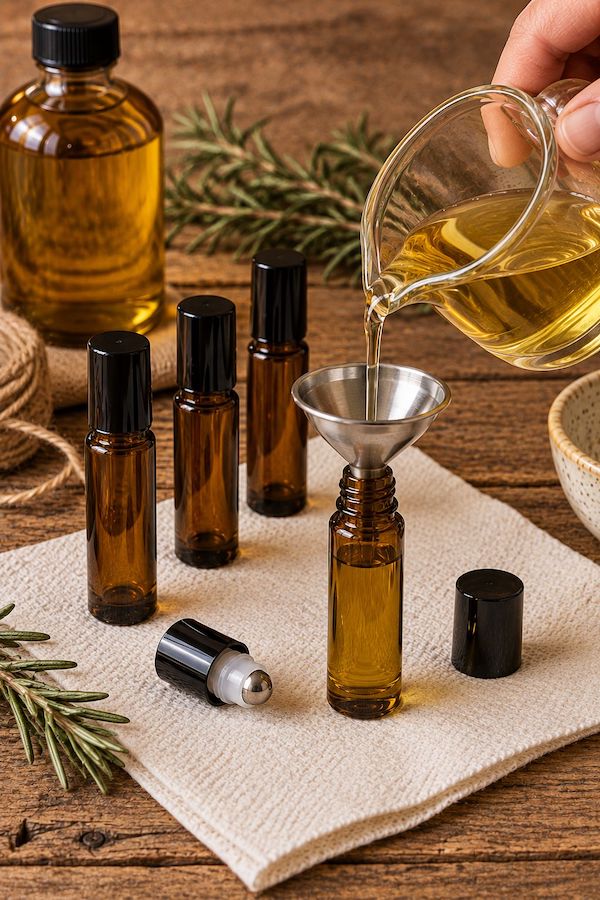
How to read the amounts
All amounts are given in millilitres and US teaspoons. Anything with butter or wax is also given by weight, because a kitchen scale is the one measure that works the same everywhere.
- 1 tsp = 5 ml
- 1 tbsp = 15 ml
- 1 fl oz = 30 ml
- 1 oz = 28 g
A metric teaspoon is 5 ml and a US teaspoon is just under, which makes no practical difference at this scale.
The safety rules that apply to every gift
These cover all 20 ideas, so I’m saying them once.
- Patch test first. Put a little of any new blend on the inner arm and wait at least 24 hours before wider use. The American Academy of Dermatology suggests that for a product you’ll leave on the skin, testing twice daily for seven to 10 days gives a more reliable answer.
- Keep it away from the eyes. For anything used near the eyes, say so clearly on the card and tell people to stop if there’s any irritation.
- Do not promise growth. These are conditioning and nourishing blends.
- Skin and hair only. These gifts are not for swallowing.
- Label every bottle with the ingredients and the date made. I suggest 6 to 12 months for blends.
- Keep essential oils low. Any essential oil must be diluted, and unscented is always the safest default.
Worth knowing: the Cosmetic Ingredient Review also found that castor oil and ricinoleic acid can help other chemicals pass through the skin. That’s one more reason to keep essential oils to a minimum in a castor oil blend.
“Unscented” isn’t always fragrance-free. The AAD warns that products labelled unscented, or made with plant-based botanical ingredients, may still contain fragrance-related ingredients. And the Tisserand Institute points out that an essential oil in a bottle is 50 to 100 times more concentrated than in the plant. If a gift is for a coworker, leave the essential oils out entirely.
Gifts for her: face and lips
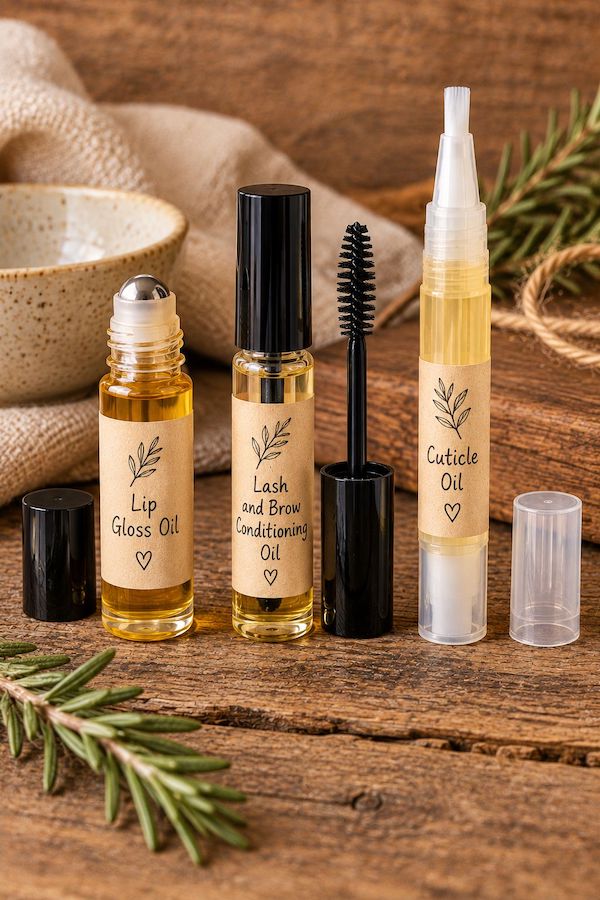
1. Lash and brow conditioning oil
A small tube with a brush suits anyone who likes a tidy routine. Castor oil makes a tempting lash product, but the claims need care. Dermatologists are clear that there’s no good evidence it grows lashes, so I describe this as conditioning only.
- Blend (10 ml): 5 ml (1 tsp) castor oil + 5 ml (1 tsp) jojoba oil + 1 drop vitamin E. No essential oils, because this sits near the eyes.
- Bottle: mascara-style tube with a brush, or a lip gloss tube.
- Label: Lash and Brow Conditioning Oil.
Apply near the lash line and brows, never in the eye. Stop if there’s any irritation. Vitamin E is available if you need it.
2. Glossy lip oil
Castor oil is the reason many lip glosses look shiny, which makes this the most naturally giftable idea of all.
- Blend (10 ml): 6 ml (1¼ tsp) castor oil + 4 ml (¾ tsp) sweet almond oil. For a thicker, glossier finish, use 7 ml castor oil and 3 ml sweet almond oil.
- Bottle: roller or lip gloss tube.
- Label: Lip Gloss Oil. Keep it unflavoured for a gift.
3. Cleansing and makeup-melting oil
Oil cleansers work by dissolving oil-based makeup, and a little castor oil adds slip. Keep its share low, because too much feels heavy and is hard to remove.
- Blend (50 ml / 1.7 fl oz): 5 ml (1 tsp) castor oil + 45 ml (3 tbsp) jojoba or sweet almond oil.
- Bottle: small pump bottle pump bottle.
- Label: Melt-Away Cleansing Oil.
Tell the recipient to massage it onto dry skin and remove it with a warm, damp cloth. A plain oil cleanser has no emulsifier, so it won’t rinse clear with water alone. Keep it away from the eyes.
For more ways to keep skin comfortable, point them to my hydrating skincare ideas.
4. Cuticle oil pen
Small, practical and loved by anyone who types, washes dishes or wears nail polish.
- Blend (10 ml): 2.5 ml (½ tsp) castor oil + 7.5 ml (1½ tsp) jojoba oil + 1 drop vitamin E.
- Bottle: twist-up pen or roller.
- Label: Cuticle Oil.
Gifts for hair lovers
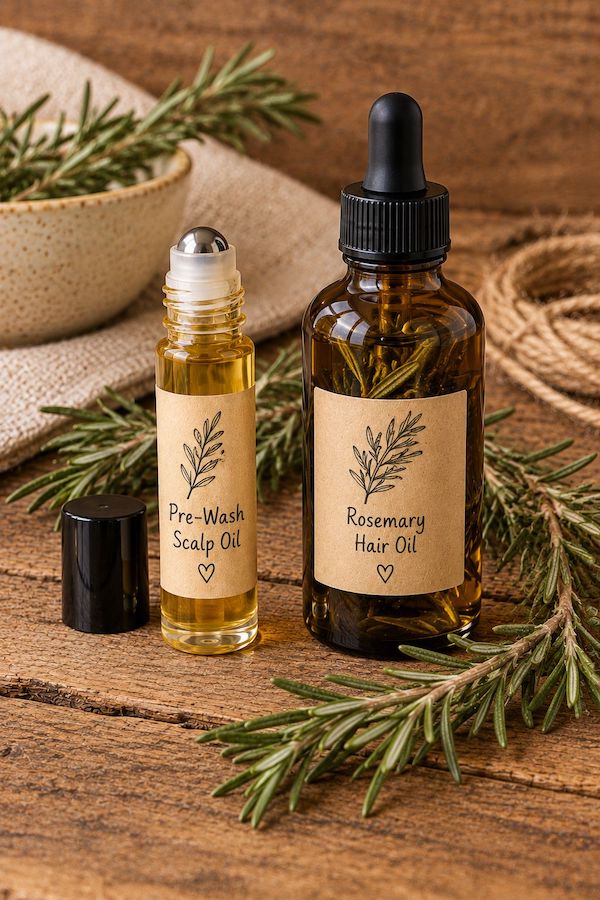
5. Pre-wash scalp oil
Applied before shampooing, it’s a classic for dry or tight scalps. Say “conditioning”, not “growth”. If your recipient asks about growth, my natural hair growth tips cover what actually helps.
- Blend (30 ml / 1 fl oz): 7.5 ml (1½ tsp) castor oil + 22.5 ml (1½ tbsp) sweet almond oil.
- Bottle: roller with a wide ball.
- Label: Pre-Wash Scalp Oil.
6. Split-end sealing oil
Oil can’t repair a split end, but it can smooth the look of one. A tiny amount on the lengths does the job. For other options, see my natural thick hair remedies.
- Blend (10 ml): 1.25 ml (¼ tsp) castor oil + 8.75 ml (1¾ tsp) argan oil. Castor oil is a small share on purpose, because it’s heavy on fine ends.
- Bottle: narrow-neck bottle with a reducer cap.
- Label: Ends Sealing Oil.
7. Edges oil with a spoolie
A small brush makes it easy to smooth fine hairs without a greasy hand.
- Blend (10 ml): 5 ml (1 tsp) castor oil + 5 ml (1 tsp) jojoba oil.
- Bottle: tube with a spoolie spoolie brushes.
- Label: Edges Oil.
8. Rosemary-infused castor oil
A lovely gift for anyone who likes a bit of ritual. Use dried rosemary only, because water in fresh herbs invites mould. This is traditional use, not a proven hair treatment.
- Blend (30 ml / 1 fl oz): 1 tbsp (about 2 g) dried rosemary + 20 ml (4 tsp) jojoba oil, with 10 ml (2 tsp) castor oil added after infusing.
- Bottle: amber bottle with a reducer cap.
- Label: Rosemary Hair Oil.
- Put the dried rosemary and jojoba oil in a heatproof jar.
- Stand the jar in a pan of hot (not boiling) water for 2 hours, keeping the oil around 60°C / 140°F.
- Strain through a fine cloth or coffee filter and let it cool.
- Stir in the castor oil and 1 drop of vitamin E, then bottle and label.
If you’d rather scent with essential oil, rosemary essential oil works, kept very low.
Gifts for him, hands and feet
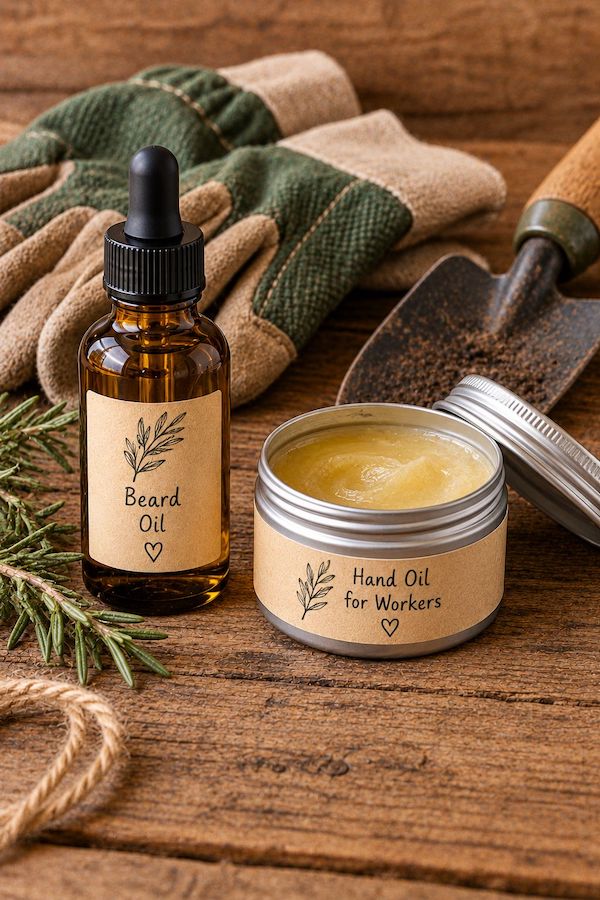
9. Beard oil
The most obvious gift for him, and the one that needs the most care. Keep it lightly scented or unscented, and warn him about the eyes.
- Blend (30 ml / 1 fl oz): 2 ml (a scant ½ tsp) castor oil + 16 ml (1 tbsp + ¼ tsp) jojoba oil + 12 ml (2½ tsp) argan oil. Optional: up to 3 drops of cedarwood or lavender essential oil in total, which is roughly a 0.5% dilution.
- Bottle: narrow-neck bottle with a reducer cap.
- Label: Beard Oil.
Castor oil is a small share because it gets sticky in a beard. Keep it away from the eyes.
10. Gardener’s hand oil
A tin for people who work with their hands. Thick enough to feel protective, light enough not to leave tools slippery.
- Blend (30 g / 1 oz tin): 5 g (0.18 oz) castor oil + 15 g (0.5 oz) sweet almond oil + 10 g (0.35 oz) shea butter.
- Bottle: metal tin or glass jar.
- Label: Hand Oil for Workers.
Melt the shea gently, stir in the oils, pour into the tin and let it set. It ends up as a soft, creamy balm.
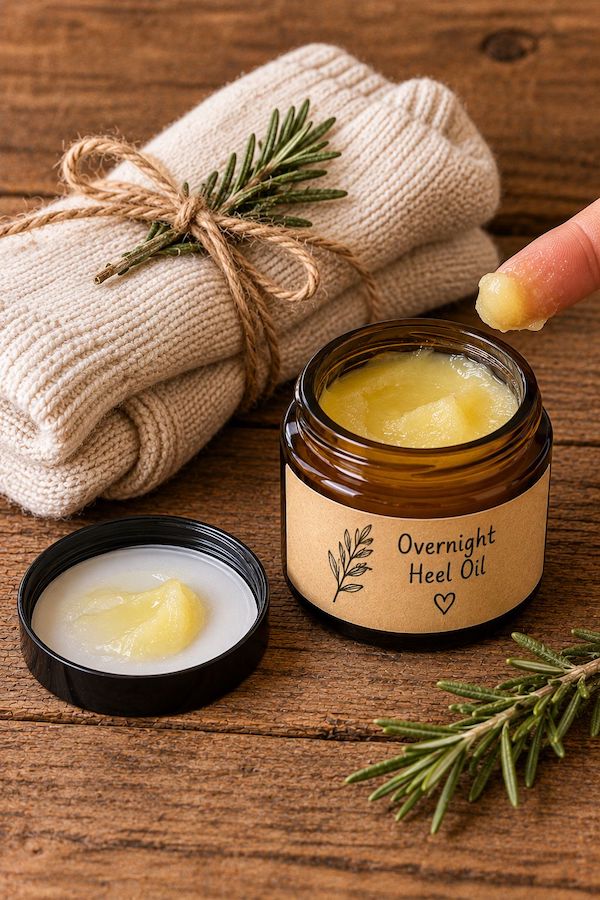
11. Overnight heel oil, with cotton socks
Apply before bed and cover with socks. The socks are part of the gift, and they keep the grease off the sheets.
- Blend (30 g / 1 oz jar): 15 g (0.5 oz) shea butter + 10 g (0.35 oz) sweet almond oil + 5 g (0.18 oz) castor oil.
- Bottle: glass jar or tin.
- Label: Overnight Heel Oil.
Make it the same way as the hand oil. It’s richer, which is what you want under socks. Add cotton socks to the gift.
Why heels crack: Mayo Clinic explains that cracked heels usually develop when the skin around the rim of the heel is dry and thickened, and pressure on the fat pad underneath makes it split. That’s why a rich balm plus socks overnight beats a quick rub. The AAD adds that severe cracks can sometimes point to a medical condition such as diabetes, so see a doctor if they don’t improve.
For more on keeping feet comfortable, see my guide to toenail health.
12. Rough-spot bar for elbows, knees and heels
A solid bar is mess-free and travels well. It needs wax, and candelilla is harder than beeswax, so it needs a lower proportion.
- Blend (60 g / 2 oz, fills two 30 g tins): 6 g (0.2 oz) candelilla wax + 18 g (0.65 oz) shea butter + 12 g (0.4 oz) castor oil + 24 g (0.85 oz) sweet almond oil.
- Bottle: two 30 g tins or a push-up tube.
- Label: Rough-Spot Bar.
- Melt the wax first.
- Add the butter, then the oils.
- Pour into the tins and let them cool.
Sets and formats
13. Trio of mini bottles
Three 10 ml bottles in a small box: lip oil (idea 2), cuticle oil (idea 4) and edges oil (idea 7), say. The easiest gift on this list, and the most photogenic.
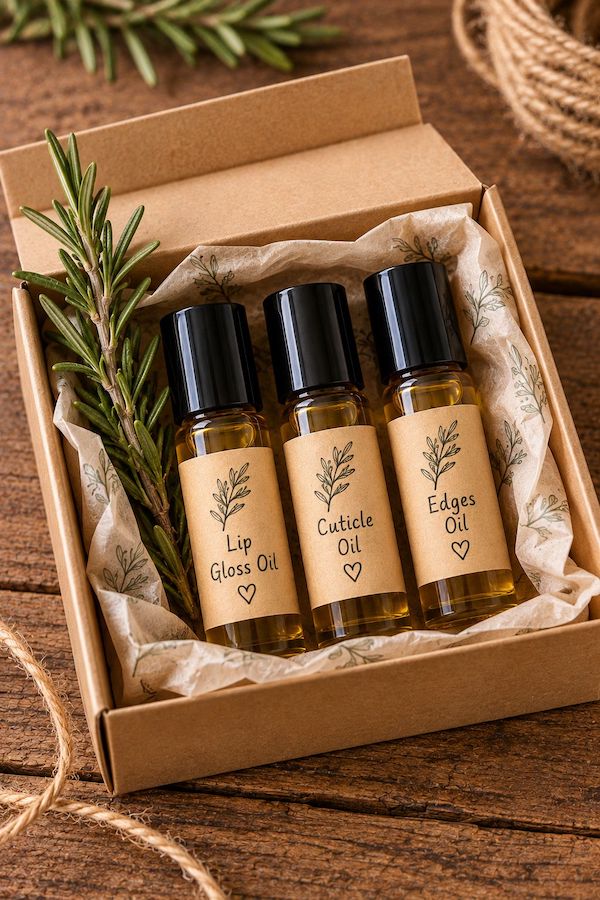
For the full method, see DIY castor oil gift set.
14. Travel set of 10 ml bottles
Pre-wash scalp oil, cuticle oil and lip oil, all small enough for a washbag. Use the 10 ml amounts above and scale the scalp oil down to a third.
15. Regular and Jamaican black castor oil duo
Fill two 10 ml bottles with the pure oils and add a card explaining the difference. Without it, the recipient won’t know why they’ve been given two.
Check here my post explaining the difference between the two oils in detail!
Regular castor oil is pale, mild and cold-pressed from raw beans. Jamaican black castor oil is traditionally made from roasted beans, which makes it darker, smokier and thicker. Their main fatty acid is the same, and I’m not aware of good evidence that one outperforms the other. Choose by texture and scent. Blend with a lighter oil before use, and patch test first. Keep away from the eyes.
16. Make-your-own kit
Good for the person who likes projects. Include a funnel, empty bottles, 30 ml (1 fl oz) of castor oil, 90 ml (3 fl oz) of jojoba oil and a recipe card.
For a simple conditioning blend, mix 1 part castor oil with 3 parts jojoba oil. For a 10 ml bottle, that’s 2.5 ml (½ tsp) castor oil and 7.5 ml (1½ tsp) jojoba oil. Add 1 drop of vitamin E, shake gently, label with the date and patch test before use.
Small gifts in bulk
17. Christmas card with a mini bottle attached
One 10 ml roller of lip oil or cuticle oil, one tag, one stamp. Tie it to the card with twine twine and it posts well too.
18. Coworker, teacher and neighbour gifts
Go unscented by default at work, because fragrance sensitivities are real. The cuticle oil pen or a small tin of hand oil suits almost everyone.
Keep the tag simple and free of health claims, for example: “Thank you for a brilliant year. Hand oil, made for busy hands.”
For a batch method, see [LINK: cheap castor oil gifts for coworkers].
19. Self-care night box
Oil, cotton socks, an eye mask and a herbal tea. The oil is the anchor and the rest is comfort. For a scented item, check for allergies before gifting.
For the step-by-step version, see [LINK: castor oil self-care gift box].
20. Winter tin
A small tin of rough-spot balm for hands, elbows and heels. Pair it with my winter skincare routine for anyone who wants the full plan.
Looking for more ideas for him? See [LINK: castor oil gifts for men].
Presentation that makes it look expensive
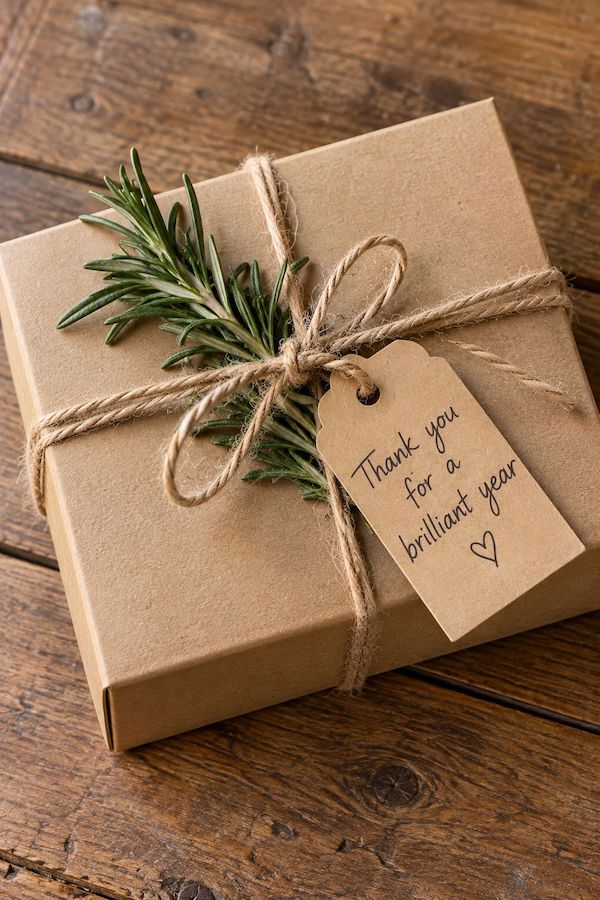
- Use kraft boxes, plain tins and a single neat label.
- Add twine and a sprig of dried rosemary.
- Write a short how-to-use card, with no health claims.
- Keep the label readable and the bottle clean.
You’ll also need labels and gift tags.
Storage and shelf life
Store gifts in a cool, dark place, away from direct sunlight and heat. Castor oil itself is fairly stable, but blends with lighter oils and extras don’t last forever.
Vitamin E helps slow oxidation, but it isn’t a preservative. If the oil smells sharp or rancid, throw it away. Use clean hands or tools, and never let water into the bottle.
Frequently asked questions
Is castor oil a good gift?
Yes, provided it’s a blend and clearly labelled. It’s inexpensive, familiar and useful, but only if it feels good to use.
How long does a homemade blend last?
Aim for 6 to 12 months, kept cool and dark, with the date made on the label.
Can I gift pure castor oil?
You can, as in the duo above. Add a card saying it’s thick, that it should be blended with a lighter oil, and that a patch test comes first.
Is it safe for sensitive skin?
Castor oil itself is rarely irritating, but added essential oils can be. For sensitive skin, go unscented and patch test.
Doesn’t castor oil come from a poisonous plant?
The raw bean contains ricin, which is toxic. Ricin is not oil-soluble, and does not pass into the oil during pressing and steam treatment, so commercial castor oil is free of it. Buy from a reputable seller, and never try to process the beans yourself.
Conclusion
One bottle, 20 gifts, and nobody needs to know it cost pennies. The trick isn’t the oil. It’s the right base, a bottle that doesn’t clog, an honest label and a patch test.
When the four detailed guides are live, they’ll cover the mini bottle set DIY castor oil gift set, gifts for men [LINK: castor oil gifts for men], bulk gifts [LINK: cheap castor oil gifts] and the self-care box [LINK: castor oil self-care gift box].
References
- Cosmetic Ingredient Review: Final report on the safety assessment of Ricinus communis (castor) seed oil and related ingredients. International Journal of Toxicology, 2007
- Vieira et al.: Effect of ricinoleic acid in acute and subchronic experimental models of inflammation. Mediators of Inflammation, 2000
- Vieira et al.: Pro- and anti-inflammatory actions of ricinoleic acid, similarities and differences with capsaicin. Naunyn-Schmiedeberg’s Archives of Pharmacology, 2001
- American Academy of Dermatology: How to test skin care products at home
- American Academy of Dermatology: How to care for dry, cracked heels
- Mayo Clinic: At-home treatments often heal dry, cracked heels
Love, Patri xx
