

DIY Castor Oil Gift Set: How To Turn One Big Bottle Into Mini Gifts
Most homemade gifts get one polite thank-you and a one-way trip to the back of a drawer.
You know the ones. The candle that smells of nothing in particular. The bath bomb that turned the tub blue…
A little bottle of oil that someone reaches for every single day is a different story.
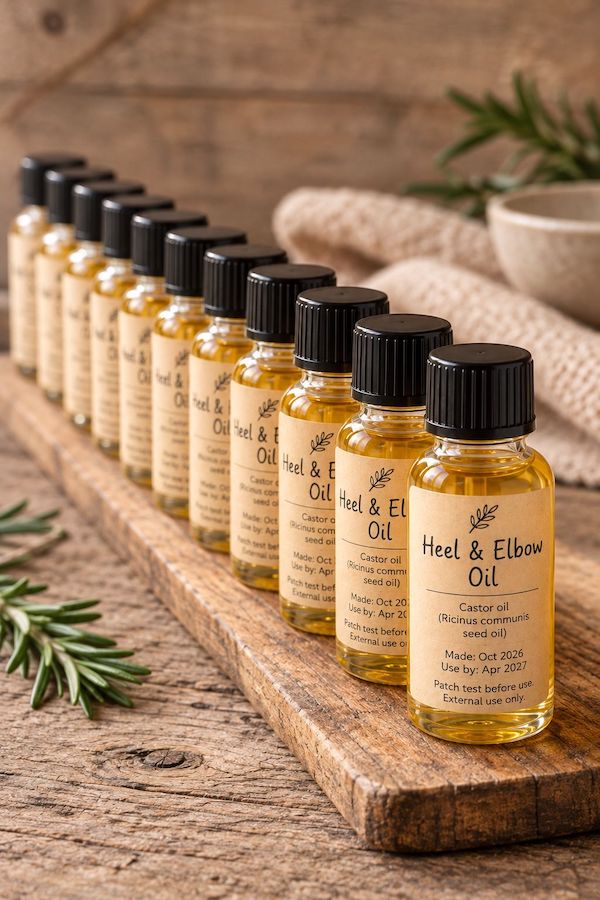
And here is the part your bank balance will like. One litre of castor oil fills roughly 90 small bottles.
Ninety. From one big bottle.
That is the whole idea behind a DIY castor oil gift set. Buy once, decant into small labelled bottles, and hand out lip oil, cuticle oil and heel oil to everyone on your list.
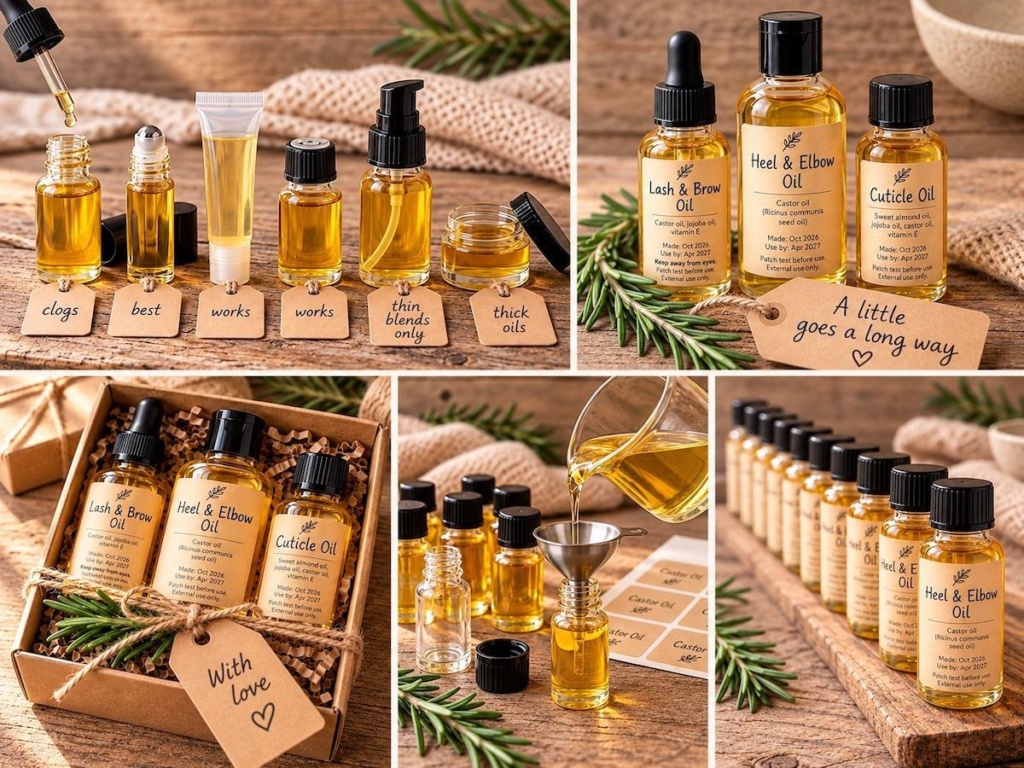
There is a catch, though, and it is the reason so many homemade oil gifts disappoint.
Castor oil is thick. Properly, stubbornly thick.
Pour it into the wrong bottle and your friend gets a clogged dropper, a sticky thumb and a gift that follows the candle into the drawer.
The fix is easy once you know it: the right bottle, a sensible blend and a proper label. That is exactly what this guide walks you through.
This is part of my castor oil gift series. If you want the full range of ideas, start with the castor oil gift ideas hub.
I’m Patri Hernández, a certified organic skincare formulator and dermocosmetic technician with a background in health coaching. I specialise in natural skincare, botanical ingredients and practical, evidence-informed approaches, so every blend here is built to feel lovely to use and be safe to give.
Some links in this post may be affiliate links, which means I may earn a small commission if you buy through them, at no extra cost to you. It never influences what I recommend, and I only suggest things I genuinely believe are useful.
What one bottle of castor oil does for your gift list
Here is what you actually get out of this, in plain terms:
- Dozens of gifts from one bottle. A litre makes about 90 small bottles, so the oil itself costs very little per gift.
- One session for the whole list. Mix once, fill a row of bottles, label and wrap. No separate recipe for every person.
- No clogged droppers or sticky thumbs. The bottle guide below shows which types cope with a thick oil and which to skip.
- Gifts people really use. Lip, cuticle and heel oils are everyday things, not shelf decoration.
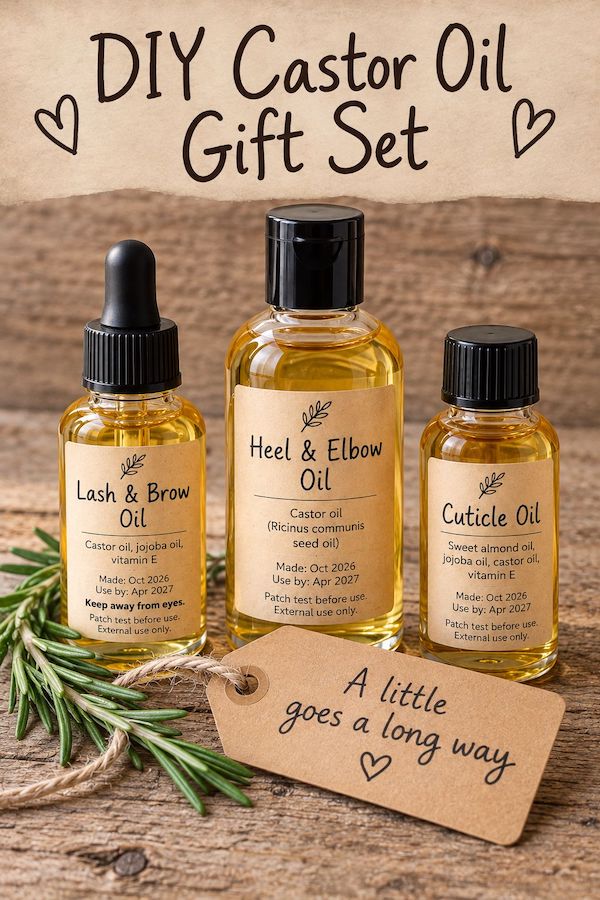
- Safe to hand over. Ingredients, date and a patch test note go on every label, so nobody has to guess what is inside.
- No awkward health promises. The gift tag wording is ready to copy and sticks to what the evidence supports.
- Three different gifts from one base. A pure oil for dry patches, a gentle blend for lashes and brows, and a light cuticle oil.
Good to know: People have valued this oil for a very long time. Castor seeds have been found in ancient Egyptian tombs dating back to around 4000 BC, so you are gifting something with serious history.
How far one bottle goes
Here is roughly what each size gives you, allowing about 10% for the oil that stays on the funnel and the sides of the jug.
| Big bottle | Fills about |
|---|---|
| 1 litre (about 34 fl oz) | 90 bottles of 10 ml (⅓ fl oz) |
| 946 ml (32 fl oz) | 85 bottles of 10 ml (⅓ fl oz) |
| 473 ml (16 fl oz) | 42 bottles of 10 ml (⅓ fl oz) |
Work out your own cost per gift
Prices change from shop to shop and from country to country, so here is a quick way to get your own number in a minute.
- Divide the price of your big bottle by the number of small bottles it fills. That is the oil cost per bottle if you fill it with pure castor oil.
- Add the price of one empty bottle. Multipacks of 10 or more usually work out cheaper per bottle.
- Add the price of one label, plus a little for twine or a gift tag if you are wrapping.
Example only: if a litre of castor oil costs 20 in your currency, the oil for one bottle comes to about 0.22 (20 divided by 90). Swap in your own prices.
In most cases the bottle and the label cost more than the oil, so that is where buying in bulk saves you the most.
Blends use less castor oil per bottle, but jojoba is usually the priciest oil in the set. A blend can end up costing a little more than a pure oil, and it feels nicer to use.
What to buy for 10 gift sets
One set is one bottle of each blend below: pure castor oil, the lash and brow blend and the cuticle oil. For 10 people that is 30 bottles.
Here is how much of each ingredient it takes, with a little spare for waste. Use the nearest bottle size you can find.
| Ingredient | Needed for 10 sets | Buy about |
|---|---|---|
| Regular castor oil | 170 ml (about 5¾ fl oz) | 250 ml (8 fl oz) |
| Jojoba oil | 90 ml (about 3 fl oz) | 120 ml (4 fl oz) |
| Sweet almond oil | 40 ml (about 1⅓ fl oz) | 60 ml (2 fl oz) |
| Vitamin E | 20 drops | One small bottle |
| 10 ml (⅓ fl oz) bottles | 30 | 33, so you have spares |
| Labels | 30 | 36 |
Making 5 sets? Halve everything. Only making cuticle oil for 10 people? You need just 20 ml of castor oil, 40 ml of jojoba and 40 ml of sweet almond oil.
What you need
- Cold-pressed, hexane-free castor oil: regular castor oil. Hexane is a solvent used in some industrial extraction, and I would rather it was not in anything I give as a gift.
- Jamaican black castor oil (optional): Jamaican black castor oil for a darker, more rustic bottle.
- Jojoba oil: jojoba oil, very stable and light on the skin.
- Sweet almond oil: sweet almond oil, a soft, familiar oil for cuticle blends.
- Vitamin E: vitamin E, to help slow oxidation in the lighter oils.
- Bottles of 10 ml (⅓ fl oz): roller bottles, amber glass bottles with reducer caps or lip gloss tubes.
- Small containers for thicker oils: glass jars or 0.5 oz (15 ml) metal tins.
- Finishing kit: small funnel, a jug with a spout, labels, and 70% isopropyl alcohol (rubbing alcohol in the US).
Why is it so thick? Castor oil is about 90% ricinoleic acid, a fatty acid with an extra hydroxyl (OH) group on its chain. Researchers link castor oil’s unusually high viscosity to hydrogen bonding between those molecules.
In everyday terms, the molecules hold hands, so the oil refuses to flow.
Plot twist: jojoba is not technically an oil. Chemically it is a liquid wax, and wax esters make up around 25 to 30% of human sebum. That is why it feels light, sits nicely on skin and keeps so well.
A quick word on Jamaican black castor oil. It is traditionally made from roasted beans, which gives the dark colour and smoky scent.
I am not aware of comparative studies showing it works better than regular castor oil. I would use regular castor oil for anything near the eyes, and keep the black version for hands, heels and general gifting.
Choosing bottles for a thick oil
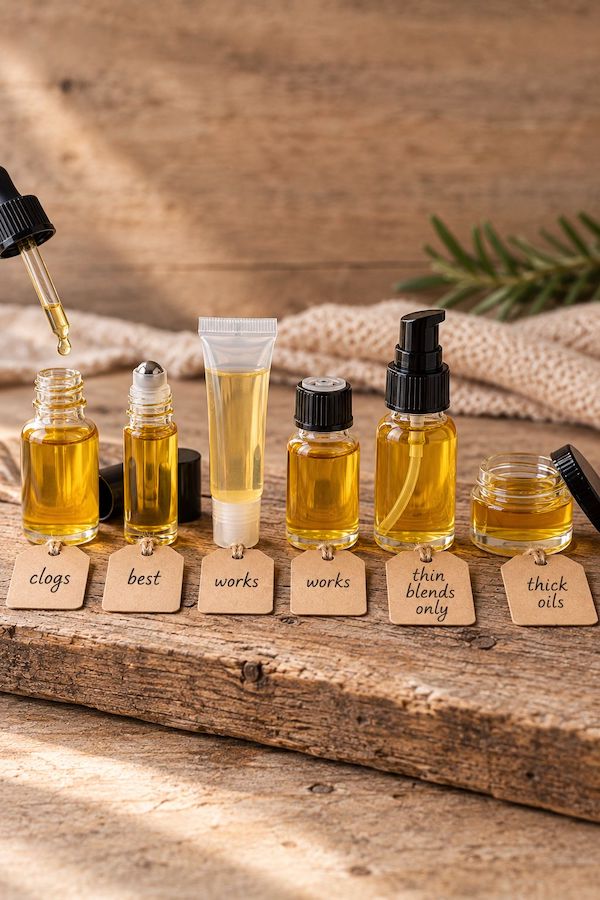
This is where most homemade sets go wrong. Castor oil is very viscous, so the bottle has to cope with it.
| Bottle type | Works with castor oil? | Why |
|---|---|---|
| Dropper bottle | Poorly | The narrow pipette clogs and the oil crawls up it. Fine only for much thinner blends. |
| Roller bottle | Yes, best for blends | The ball dispenses a thin, even layer with no mess. Pure castor oil rolls slowly. |
| Lip gloss tube with wand | Yes | The wide opening and wand suit a thick oil, and it is easy to control near lips and brows. |
| Narrow-neck bottle with reducer cap | Yes | The reducer controls the flow without clogging. |
| Pump bottle | Only for thinner blends | Pure castor oil is too thick for most pumps. |
| Glass jar or tin | Yes, for balms and thick oils | Wide and easy to scoop. Not ideal for liquid oils you want to apply neatly. |
If you only buy one type, make it the roller bottle. It is the best single answer to the clogging problem.
Amber glass is a smart second choice. Light and air both age oils, and amber glass or metal containers help slow that down.
Why lip tubes work so well: castor oil is the reason lipstick glides. The Cosmetic Ingredient Review lists lipstick as the product with the highest reported use of castor oil, at 81%.
Three ways to fill a bottle
All amounts below make 5 bottles of 10 ml (⅓ fl oz) each, a small batch of 50 ml (about 1¾ fl oz). A mistake costs you very little, and it is plenty for a trial run before you scale up.
Use cold-pressed, hexane-free oil. Pure castor oil is thick and sticky, which is why two of the three bottles are blends with a lighter oil. Treat the ratios as a starting point and adjust them after your first batch.
Pure castor oil for dry patches
- Per bottle: 10 ml (2 tsp, about ⅓ fl oz)
- Batch of 5: 50 ml (10 tsp, about 1¾ fl oz)
Fill a narrow-neck bottle with a reducer cap, or a small jar. This is for heels, elbows and knees, the places that get properly dry in winter.
It is thick, so tell the recipient a little goes a long way. This is the easiest of the three, with the fewest ingredients to react to.
Lash and brow conditioning blend
This is a blend, not pure castor oil. Keep it well away from the eyes.
Use a 1:1 ratio, about 50% castor oil and 50% jojoba.
| Ingredient | Per 10 ml bottle | Batch of 5 (50 ml) |
|---|---|---|
| Regular castor oil | 5 ml (1 tsp) | 25 ml (5 tsp, about ⅚ fl oz) |
| Jojoba oil | 5 ml (1 tsp) | 25 ml (5 tsp, about ⅚ fl oz) |
| Vitamin E | 1 drop | 5 drops |
That keeps vitamin E at roughly 0.5% of the blend. Fill a lip gloss tube with a wand.
Describe this as a conditioning, nourishing oil for lashes and brows, and leave it there. The evidence for castor oil growing lashes or brows is much weaker than the internet suggests (more on that in the FAQ).
If hair growth is what someone is really after, my natural hair growth tips are a better place to start.
Cuticle oil
Use a 2:2:1 ratio, about 40% sweet almond oil, 40% jojoba and 20% castor oil.
| Ingredient | Per 10 ml bottle | Batch of 5 (50 ml) |
|---|---|---|
| Sweet almond oil | 4 ml (about ¾ tsp) | 20 ml (4 tsp, about ⅔ fl oz) |
| Jojoba oil | 4 ml (about ¾ tsp) | 20 ml (4 tsp, about ⅔ fl oz) |
| Regular castor oil | 2 ml (about ½ tsp) | 10 ml (2 tsp, about ⅓ fl oz) |
| Vitamin E | 1 drop | 5 drops |
Cuticle oil is easy to gift because it is useful, small and fragrance-free. A roller bottle suits it nicely.
I would leave out essential oils unless you are certain about the recipient’s skin.
A note on measuring: US teaspoons (4.93 ml) and metric ones (5 ml) differ by too little to matter at these quantities. For anything larger than a batch of five, use a jug marked in ml or a small digital scale.
Step by step: sterilise, fill, cap and label
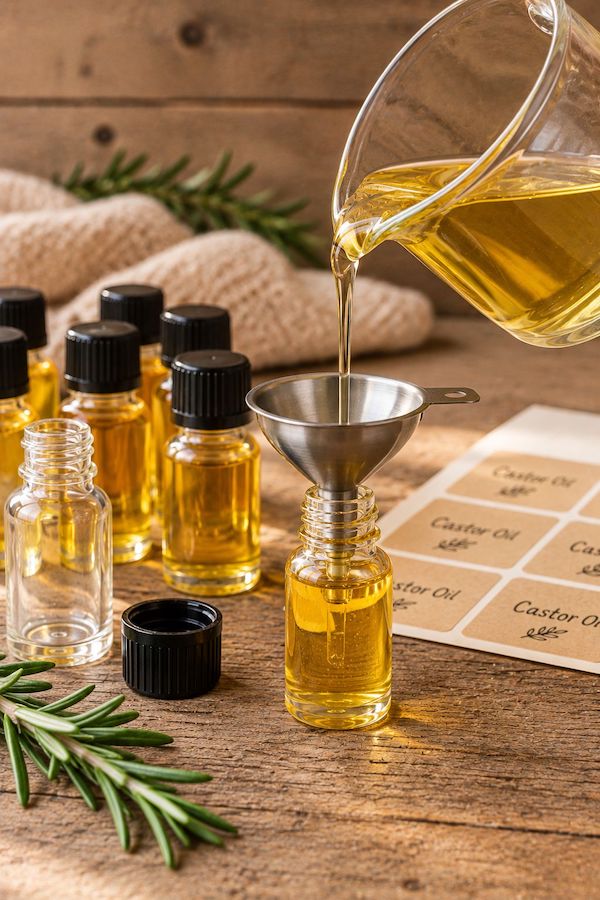
- Wash and rinse the bottles, then wipe the inside and the caps with 70% isopropyl alcohol (rubbing alcohol) or 70% ethanol.
- Let everything dry completely. Any leftover water can encourage bacteria and spoil the oil.
- Warm the castor oil. Stand the bottle in a jug of warm water, around 40 to 50°C (105 to 120°F), for a few minutes. It will pour much more easily.
- Measure your blend into a jug with a spout. Stir gently so you do not whip in air bubbles.
- Fill through the funnel, leaving about 5 mm (¼ inch) of space at the top.
- Cap tightly, wipe the outside clean and then add the label. Labelling last keeps it tidy.
Mixing in a jug first, rather than pouring each oil straight into the bottle, gives you a more even blend and makes the amounts easy to repeat next time.
Cold kitchen? Warm the oil a little longer. Castor oil gets noticeably thicker as it cools.
Vitamin E is not a preservative. As cosmetic chemist Perry Romanowski explains, vitamin E is an antioxidant that slows oils going rancid, but it does not stop microbes.
Oil-only blends have no water, which helps, yet damp bottles and wet fingers can bring moisture in. So dry everything properly, and tell recipients to keep their fingers out of the bottle.
What goes on the label
A label is not decoration. It is the safety information for whoever receives the gift.
- The name of the product
- Every ingredient
- The date you made it
- A suggested use-by date
- Patch test before use. External use only.
- Keep away from the eyes (put this prominently on the lash and brow blend)
I suggest 6 to 12 months for blends. Plain castor oil on its own typically lasts 12 to 24 months unopened, but the lighter oils and vitamin E age differently, and a blend is only as stable as its shortest-lived ingredient.
If you ever sell these, different rules apply, including a formal safety assessment. Keep this guide for gifts.
Gift tag wording you can copy
None of these make health claims.
Pure castor oil: A little goes a long way. Smooth onto dry heels, elbows and knees.
Lash and brow blend: A conditioning oil for lashes and brows. Use a very small amount, keep away from the eyes and stop if it irritates.
Cuticle oil: Massage a tiny drop into each nail and cuticle. Lovely after washing your hands.
Presentation
Keep it simple. Three small bottles in a kraft box tied with twine look far more expensive than they are.
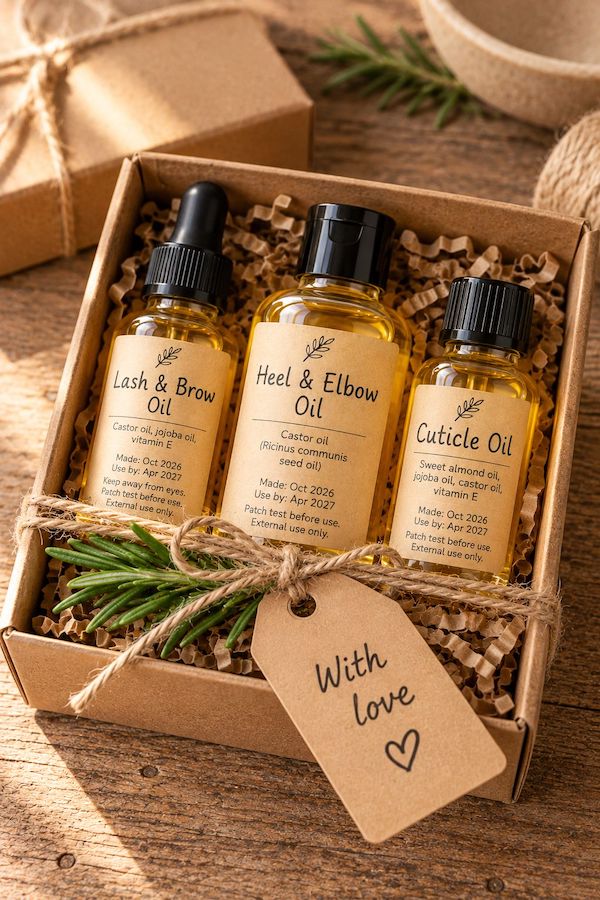
A sprig of rosemary tucked under the twine adds colour and scent. Keep it outside the bottle, as plant material and water in oil will spoil it.
Winter dryness is the main reason people reach for these oils, so a note pointing to my winter skincare routine makes a nice extra.
Five mistakes that spoil a homemade oil gift
- Using a dropper bottle. The oil is too thick and the tip clogs.
- Filling damp bottles. Water in oil is how blends spoil early.
- Labelling before wiping. A sticky bottle ruins the label and the look.
- Skipping the date and ingredients. The recipient needs both.
- Promising results. “Grows lashes” on a tag is a claim the evidence does not support.
Safety and shelf life
- Patch test any new blend on the inner arm and wait 24 hours before wider use. The American Academy of Dermatology suggests applying the product twice a day for 7 to 10 days for a thorough test, and notes that even products labelled hypoallergenic, natural or clean can cause a reaction.
- Keep blends away from the eyes, and stop using one near the eyes if there is any irritation.
- Do not swallow castor oil. These are skin products only.
- Label every bottle with the ingredients and the date made.
- Store in a cool, dark place below 25°C (77°F), away from heat and sunlight.
- Keep water out of the bottle, and keep fingers out too.
- Save these for skin, lips and nails rather than hair masks. A case report described sudden, severe matting of long hair after castor oil mixed with coconut oil was applied and washed out with warm water. It is rare, but it is a good reason not to pitch these as hair treatments.
The Cosmetic Ingredient Review panel found castor oil safe in cosmetics at current use levels, and not a significant irritant or sensitiser in human tests. It also noted that castor oil can increase the skin penetration of other substances.
That is why I keep essential oils very low in a gift, and leave them out entirely for anyone I do not know well. The AAD also warns that products labelled “unscented” or full of plant botanicals can still contain fragrance-related ingredients, so fragrance-free is the safest way to gift.
Plenty of bloggers share oil recipes without any formulation training and without checking what the science supports. That is why I keep the claims here modest.
FAQ
How long will a homemade castor oil blend last?
A sensible guide is 6 to 12 months, kept cool and dark with the cap on. If it smells sharp, rancid or different, throw it away.
Can I gift pure castor oil?
Yes, but warn people that it is thick and sticky, and give it in a bottle that will not clog. Most people prefer a blend.
Will castor oil make lashes or hair grow?
There is no strong evidence that it will. A 2022 systematic review of coconut, castor and argan oils for hair found only weak evidence that castor oil improves hair quality, and no strong evidence that it helps hair grow.
It is a good conditioner and a thick, protective emollient. That is where I would leave the claims.
Is there ricin in castor oil?
No. Ricin is a toxin found in the castor bean and it stays in the leftover mash. America’s Poison Centers state that castor oil, although made from the same seeds, does not contain ricin.
The beans themselves should never be chewed or swallowed.
Conclusion
One bottle of castor oil really can stretch to a whole shelf of gifts, as long as you pick the right bottle, blend it sensibly and label it properly.
Make a small test batch first, so the ratios and the feel of each bottle are right before you fill ten.
For more ideas, head back to the castor oil gift ideas hub.
And if you would like to use castor oil on your own hair, my natural remedies for thicker hair are a good next stop.
References
- Cosmetic Ingredient Review: Final report on the safety assessment of Ricinus communis (castor) seed oil and related ingredients (International Journal of Toxicology, PubMed)
- Use of Castor Oil in Dermatology: A Narrative Review (Cureus, via PubMed Central)
- American Academy of Dermatology: How to test skin care products before use
- Systematic review of coconut, castor and argan oils for hair (Journal of Drugs in Dermatology)
- “Castor Oil”: The Culprit of Acute Hair Felting (International Journal of Trichology, via PubMed Central)
- America’s Poison Centers: What happens if I eat castor beans?
Love, Patri xx
