
Castor Oil: What It Actually Does for Skin and Hair (And What’s Just Marketing)
I have a confession.
I actually like castor oil.
(Which is rare for me. I’m naturally sceptical of anything the internet suddenly decides is a “miracle” ingredient.)
But scroll through Pinterest for five minutes and you’d think this stuff cures everything.
Grow your lashes overnight. Fade your dark spots. Thicken your hair by 300%. Fix your gut. Even bring on labour.
I mean… where do you even start with a list like that?
Here’s the thing. Most people writing about castor oil online have never studied a fatty acid profile in their life.
They’re repeating what the last blog said. Which repeated the blog before that.
I’m a certified organic skincare formulator, so I only write what I can actually back up with real research.
Let’s go through this oil properly, shall we?
What castor oil actually is
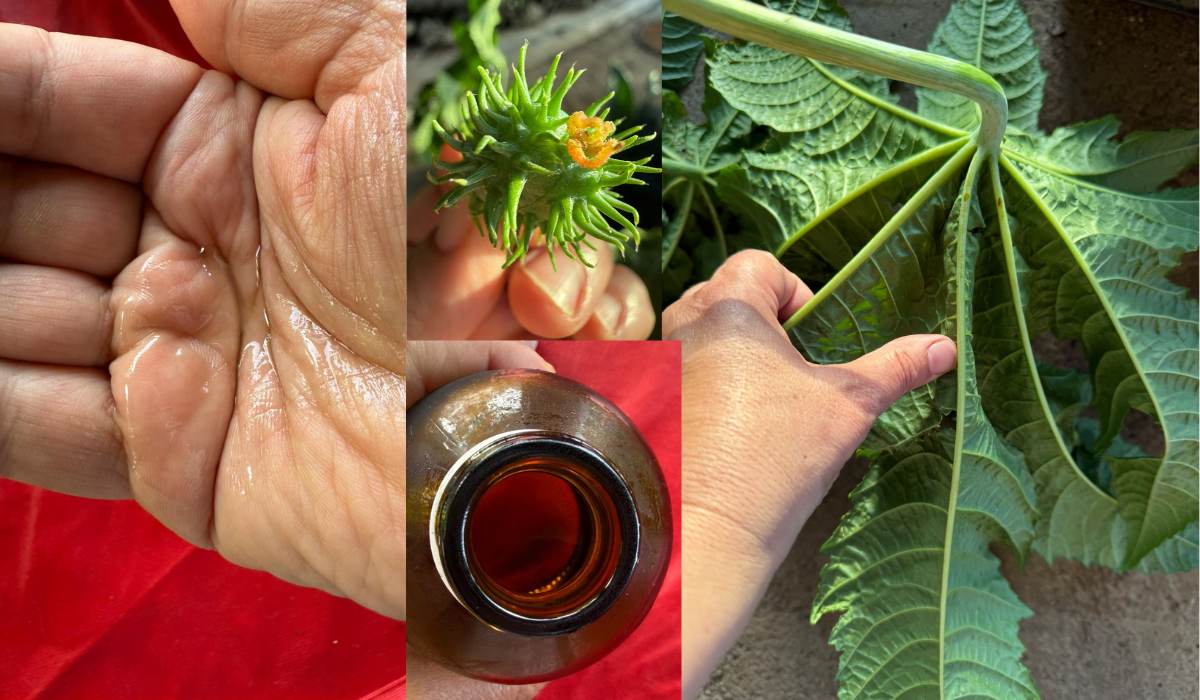
Castor oil comes from the seeds of Ricinus communis, the castor bean plant.
Press the seeds properly (cold, no heat, no solvents) and you’re left with a thick, pale yellow oil.
It’s naturally vegan, by the way. No animal ingredient has ever come near it. One less thing for you to worry about.
Quick answer: castor oil is a thick vegetable oil that’s roughly 85 to 90% ricinoleic acid, a fatty acid found almost nowhere else in nature. That one fatty acid is responsible for nearly everything this oil is known for, good and bad (PMC5015816 cites up to 90% ricinoleic, 4% linoleic, 3% oleic but do. fact check if necessary).
Now here’s the part that makes people nervous. The seeds themselves contain ricin, a genuinely dangerous toxin.
It’s removed during proper oil extraction. But it’s exactly why you should only ever buy castor oil from a reputable seller, and never, ever try to press your own at home.
Worth knowing: ricin and ricinoleic acid are not the same thing, despite the almost identical name. Ricin is a toxin that stays behind in the leftover seed cake during pressing. Ricinoleic acid is the fatty acid that ends up in your bottle. Properly made commercial castor oil contains none of the former.
A quick safety note if you’re a gardener: castor bean plants are also grown ornamentally for their dramatic leaves, and most people who plant them have no idea the seeds are toxic if chewed and swallowed. Worth keeping in mind if you have young children or pets who wander around the garden.
Here’s a genuinely strange bit of history tied to that same toxin: one of the Cold War’s most famous unsolved assassinations, the 1978 killing of Bulgarian journalist Georgi Markov in London, was carried out with ricin from castor beans, delivered through a specially rigged umbrella. It’s a dramatic illustration of exactly why proper extraction and a reputable seller matter so much. Source: PBS
A short history (it’s older than you’d think)
Castor oil has been used for around 4,000 years. Four thousand. Egyptian records describe it being used on skin and hair, and burned as lamp fuel (this claim gets repeated everywhere but the original reference is hard to pin down reliably!).
Its old nickname, “Palma Christi” (Christ’s palm), comes from the shape of the plant’s leaves. They look a bit like an open hand. Use your imagination.
It’s been part of Ayurvedic and traditional medicine for centuries, mostly as a laxative rather than a skincare product. The skincare use? Far newer than people assume.
In Ayurveda, castor oil is known as “Eranda” and is still considered one of the most-used oils in that tradition. And if you’ve ever had a grandparent threaten you with “a good dose of castor oil” as a child, you weren’t imagining it. For generations, a spoonful of it was the go-to home remedy for almost any stomach complaint, long before anyone thought to put it in a serum.
The one fatty acid that explains almost everything
Most oils on your shelf are mixes of several fatty acids in fairly even amounts.
Castor oil isn’t having any of that.
It’s dominated, overwhelmingly, by one: ricinoleic acid.
Worth knowing: ricinoleic acid is what’s called a hydroxy fatty acid. It has an extra oxygen-hydrogen group attached that most fatty acids don’t have. That’s the reason castor oil is so much thicker and stickier than, say, sweet almond or grapeseed oil.
That same structure gives it real, published biological effects:
- It activates a receptor in the body called EP3. Research has traced castor oil’s laxative and labour-inducing effects directly back to ricinoleic acid triggering this specific receptor. This is the mechanism behind the oil’s oldest, and honestly its only truly proven, use.
- It has measurable anti-inflammatory activity in lab and animal studies, alongside some pro-inflammatory effects depending on dose and context (source: PMC1781768, Mediators of Inflammation, 2000).
- It has antibacterial properties, which is part of why it’s sat in first-aid cabinets for so long.
True story: that laxative mechanism has a genuinely strange place in history. Many WWI fighter planes ran on rotary engines lubricated with castor oil, and pilots flew through a fine mist of it every time they took off. The well-documented result was that a lot of them dealt with an upset stomach mid-flight, and some reportedly carried brandy to settle it. Not exactly what you’d expect from “aviation history,” but it’s the same fatty acid doing the same job.
Worth knowing: nature doesn’t make many hydroxy fatty acids like this one in large amounts. Castor oil is genuinely one of the very few plant oils on Earth made up almost entirely of a single hydroxy fatty acid, which is part of what makes it chemically unusual rather than just “another carrier oil.”
Here’s the honest caveat, though. Almost all of that research was done on the gut, the uterus, or in test tubes.
It tells you why castor oil behaves the way it does chemically. It doesn’t automatically prove that rubbing it on your face or scalp gives you the same effect.
I’ll be specific about where the evidence actually reaches your skin, and where it stops, section by section below.
Regular vs Jamaican black castor oil: what’s actually different
Walk into any beauty aisle and you’ll see two versions sitting side by side, looking suspiciously similar. Here’s what actually separates them (besides the colour).
| Regular castor oil | Jamaican black castor oil | |
|---|---|---|
| Colour | Pale gold | Dark brown to black |
| How it’s made | Cold-pressed, unroasted seeds | Seeds are roasted first, then pressed |
| Smell | Mild, almost neutral | Smokier, nuttier |
| pH | More neutral | Slightly more alkaline (from the ash created during roasting) |
| Best for | Face, lips, cuticles, anywhere you want a milder scent | Scalp and hair, where people find the alkalinity helps lift buildup |
Neither is objectively “better,” whatever the comment sections tell you. It’s a texture and preference call more than anything. I’ve gone into far more depth, including which one to pick for which job, in my Jamaican black castor oil vs regular castor oil comparison.
What it can genuinely do for skin
This is where I need you to hold two things at once. Castor oil has real, useful properties for skin. And a lot of what’s claimed for it online outruns the evidence completely. Sorry.
Here’s the honest breakdown, area by area.
I’m not the only one saying this. One Atlanta-based dermatologist, quoted in a piece debunking the “castor oil works like Botox” claims doing the rounds online, pointed out that if it really tightened skin that way, everyone would already be using it instead of Botox. Source: Woman’s Day, via AOL
Hydration and barrier support
Castor oil is what’s called an occlusive. It sits on the surface of your skin and slows down water loss, rather than adding water itself.
That’s genuinely useful for dry patches. But it’s not a moisturiser in the way a cream with humectants (think glycerin or hyaluronic acid) is.
On its own, it works best layered over something water-based. Not instead of it.
Just how thick is it? Castor oil is noticeably thicker than most other carrier oils, sitting somewhere between honey and golden syrup on the pourability scale. That’s exactly why a little goes further than you’d expect, and why warming it slightly between your palms before use makes such a difference.
Lips
The same thick, occlusive texture that makes it heavy on oily skin is exactly what makes it so good on lips.
It seals in moisture and softens flaky, chapped skin. Honestly, this is one of the lowest-risk, most straightforward uses on this whole list. No caveats needed.
Nails and cuticles
Massaged into dry cuticles, castor oil softens them and can make ragged, hangnail-prone cuticles more manageable.
This is a texture win, though, not a growth one. Be wary of any claim that says it makes your nails grow faster. It won’t.
Cracked heels
Same logic as lips. Thick, occlusive, and good at softening hardened, dry skin when used consistently, ideally under socks overnight.
Stretch marks and scars
This is one of the most commercially pushed uses, and one of the weakest evidence bases. There’s no strong published research showing castor oil fades stretch marks or scars.
What it can do is keep the surrounding skin supple and comfortable while marks fade naturally over time, which they do regardless of what oil you use. I’d rather tell you that honestly than sell you false hope.
Hyperpigmentation and dark spots
There’s actually a specific 2024 clinical trial worth flagging here. A small, exploratory study found a castor oil cream improved the appearance of dark circles under the eyes (J Cosmet Dermatol, 2024, PMID 37927123, single-arm exploratory design, meaning no comparison group, so results need replicating before I’d call this proven!).
It’s promising. But it’s one small study, not a guarantee. I go through exactly how to use it for this purpose, safely, in Castor oil for hyperpigmentation.
Pore-clogging risk
Castor oil is generally considered low on the comedogenic scale, meaning it’s unlikely to clog pores for most people (please do fact check this rating against a proper dermatology source as most of what’s circulating traces back to an old cosmetic industry scale rather than a single, citable clinical study).
If you’re acne-prone, patch test first. Watch how your skin responds over a week or two rather than assuming it’s automatically fine.
For the fuller rundown on skin, including the parts I don’t have space for here, see 50 benefits of castor oil for skin and castor oil uses and benefits tables. For the specific ritual of leaving it on overnight, including what can go wrong, read castor oil on face overnight.
What it can genuinely do for hair
Here’s where I need to be my most honest with you, because this is where the biggest gap between marketing and research sits. Buckle up.
The growth claim
I’ll say this plainly: there is no strong, controlled clinical evidence that castor oil alone regrows hair on the scalp. A published review of the research on hair oils found genuine clinical benefit for coconut oil, but only limited evidence for castor oil’s effect on growth specifically.
What castor oil reliably does is coat the hair shaft, seal in moisture, and reduce breakage. If your hair looks longer after months of use, it’s very likely because less of it is snapping off, not because your follicles suddenly started producing more hair.
That’s not nothing, by the way. Less breakage genuinely does mean your hair holds onto length better over time. But it’s a different mechanism to what most castor oil hair-growth posts imply, and I think you deserve to know the difference.
Scalp health and dandruff
The same antibacterial and anti-inflammatory properties that show up in gut research have plausible relevance to scalp health, since a calmer, less irritated scalp environment is generally a better one for hair. This is a reasonable, if still under-researched, use.
Eyelashes and eyebrows
Same story as scalp growth, maybe even more so. There’s no clinical trial showing castor oil grows new lashes or brows.
What it does is coat individual hairs, making them look glossier and reducing breakage at the tips. That can make existing lashes and brows look fuller over time. If you want genuinely proven lash growth, that’s a different product category entirely, and I’d rather tell you that than let you wait months for a result that was never coming.
Beards, frizz, and split ends
This is squarely in the “conditioning oil” category, and it’s honestly one of castor oil’s best-supported jobs. As a leave-in or pre-wash treatment on length, it smooths the hair cuticle, cuts down on frizz, and makes split ends less noticeable between trims.
For the full, longer version of this section, including exactly how I use it and where I stop, go to castor oil for hair: what it really does (and doesn’t) and grow hair faster using castor oil. If you want a specific blend to try, I share my go-to combination in the castor and rosemary DIY hair treatment.
Castor oil packs: what they are and what’s actually proven
You’ve probably seen these all over social media by now. A cloth soaked in castor oil, placed on the abdomen, usually with a heat source on top. People use them for everything from “detoxing the liver” to easing period pain to supporting digestion.
Here’s what I can say honestly. Castor oil is FDA-approved as a stimulant laxative, and that use is genuinely well established. Let’s just say I don’t dare take it. Just in case. Always consult with your doctor first. PLEASE.
Regarding the topical pack, one small trial of elderly patients found castor oil packs were associated with some improvements, but they didn’t actually improve stool frequency, which was the main outcome people hoped for. So there you go.
Claims around “detoxing the liver” specifically don’t have strong published backing yet. There’s some early research suggesting topical castor oil may support liver function, but it needs a lot more study before I’d call it proven.
My honest take: this is not something I can responsibly recommend. Please see a doctor and follow whatever they say. Don’t follow “internet instructions”.
Where did this trend actually come from? The modern castor oil pack isn’t a recent TikTok invention. It was popularised in the 1930s by Edgar Cayce, an American psychic healer who recommended it more than any other remedy across thousands of his readings. That’s worth knowing, because it explains why the practice is so widespread despite having so little modern clinical research behind it: it caught on through one influential figure nearly a century ago, not through a study.
You’ll also see people recommending a drop of castor oil in the belly button for hormone balance or “detox.” This usually comes with a claim about something called the Pechoti gland, said to absorb oils straight into your organs. It sounds official, but it isn’t real. Your belly button is simply healed scar tissue from your umbilical cord, with no special gland or shortcut to your bloodstream behind it. Source: Healthline
Common mistakes that waste it (or make it work against you)
I see the same handful of mistakes over and over, like clockwork:
- Using far too much. A little goes a long way. This oil is thick, and a few drops cover more surface area than you’d think.
- Applying it to bone-dry skin or hair with nothing underneath. Because it’s occlusive, it works best sealing in moisture that’s already there, not being asked to hydrate on its own.
- Skipping the patch test. Especially relevant if you have plant allergies or very reactive skin.
- Expecting overnight miracles. Any real change, where it exists at all, takes weeks of consistent use, not one dramatic night.
I’ve written a full piece on this if you want the complete list: stop using castor oil like this.
A genuinely useful reference: how much do you actually need?
| Where you’re using it | Roughly how much |
|---|---|
| Face | 2 to 3 drops |
| Lips or cuticles | 1 small drop |
| Hair ends | Half a teaspoon |
| Full scalp | 1 to 2 teaspoons |
| Castor oil pack | 2 to 4 tablespoons on the cloth |
If you’re reaching for a tablespoon to put on your face, that’s your sign you’re using far more than you need.
One more practical thing nobody tells you: castor oil doesn’t dissolve in water, so it’s notorious for staining pillowcases and clothing. If you’re using it overnight, an old pillowcase or a towel over your pillow saves you from ruining the good bedding. Source: The Goodbye Company
Safety: patch testing, allergies, and who should be cautious
Castor oil is generally well tolerated, but “natural” doesn’t mean “risk-free for everyone.” Here’s what actually matters (and yes, some of it might surprise you).
Patch test first. It only takes a couple of days and it’s worth it:
- Apply a small amount of castor oil to your inner forearm.
- Leave it uncovered and undisturbed.
- Wait 24 to 48 hours.
- Check for redness, itching, or bumps before using it anywhere near your face.
Watch for plant allergies. True allergic reactions to castor oil are uncommon but documented, and they’re more likely if you already react to other plant oils or latex.
Acne-prone skin, go slowly. While it’s generally considered low-risk for clogging pores, individual skin responds differently, and heavier use can feel congesting for some people.
Never put it in your eyes. There’s a recurring social media trend of dropping raw castor oil straight into the eyes to treat floaters, cataracts, or blurry vision. Ophthalmologists have pushed back hard on this. They warn it can cause irritation, blurred vision, and even infection, since normal bottled castor oil isn’t sterile and doesn’t reach inside the eyeball where those conditions actually happen. Source: Fox News
There is genuine research behind a specific, very diluted castor oil eye drop for dry eye. But that’s a measured 2% pharmaceutical formulation tested in a proper clinical trial, worlds away from splashing the bottle from your bathroom cabinet into your eye. Source: PubMed
Pregnancy. This is the one place I want to be very direct with you. Castor oil’s ability to trigger contractions is real. A published systematic review and meta-analysis found labour induction was significantly higher in women given castor oil compared to those who weren’t, but that research was carried out under medical supervision, in a hospital, with monitoring. I’ll leave you with this link and also this link so you can check things out yourself.
Using castor oil to try to bring on labour yourself, at home, without medical guidance, isn’t something I can responsibly walk you through. If you’re pregnant and considering it for any reason, please speak to your midwife or doctor first.
This isn’t me being overly cautious for the sake of it. This is a genuinely active area of medical research, and it deserves a professional’s input, not a blog post. Even mine.
For the complete rundown of downsides and warning signs, read the bad side of castor oil for skin.
How it compares to other carrier oils
If you’re trying to work out whether castor oil is actually the right pick for what you need, here’s a quick, honest comparison. No sponsored bias here, I promise.
| Oil | Texture | Best known for | Comedogenic risk |
|---|---|---|---|
| Castor oil | Very thick, sticky | Occlusion, lash and brow conditioning, laxative (oral) | Generally low, FACTCHECK rating source |
| Jojoba oil | Light, similar to skin’s own sebum | Balancing oily and combination skin | Low |
| Coconut oil | Medium, solid below room temperature | Deep conditioning for hair | Higher, best avoided on acne-prone faces |
| Olive oil | Medium-heavy | Traditional, all-purpose, kitchen-cabinet skincare | Moderate |
None of these is “the best” oil full stop. (I know, I know, you wanted a winner.) It depends entirely on what you’re using it for and how your own skin or hair responds.
How to actually choose a bottle
Not all castor oil is created equal, whatever the label tells you. This is where a lot of people waste money on something that won’t perform.
Look for:
- Cold-pressed. Heat during extraction can degrade some of the beneficial compounds.
- Hexane-free. Hexane is a solvent used in cheaper extraction methods. You don’t want oil residue.
- Organic, where possible. Reduces the chance of pesticide residue on the seeds.
- Dark glass bottle. Castor oil degrades with light exposure over time, so packaging matters more than people realise.
I’ve put together a full buying guide with my honest picks: best castor oil for face.
If you want my go-to bottles directly, I use and recommend regular castor oil (get it here) for face and lips, and Jamaican black castor oil (get it here) for scalp and hair.
Storage, shelf life, and fixing the “it’s too thick and sticky” problem
Unopened, a good quality castor oil can last one to two years. Once opened, aim to use it within six to twelve months, kept away from direct sunlight and heat.
Why does it outlast so many other carrier oils? Oils high in polyunsaturated fats, like rosehip or hemp seed, oxidise (go rancid) quickly once opened. Castor oil’s fatty acid profile is far more resistant to that process, which is a big part of why it’s such a reliable base to blend other, more delicate oils into.
If the texture is putting you off (and I get it, it’s genuinely one of the thickest oils out there), a few small fixes make a real difference:
- Warm it slightly between your palms before applying. It thins out noticeably.
- Dilute it with a lighter oil like jojoba or grapeseed, especially for facial use.
- Use less than you think you need. A common mistake is applying it like a lotion instead of like the concentrated oil it actually is.
Quick facts worth knowing
A few things I love pulling out at parties. (I’m fun like that.)
- Ricinoleic acid, the fatty acid that makes castor oil what it is, is found almost nowhere else in the plant kingdom in this concentration.
- The plant itself, Ricinus communis, contains ricin in its seeds, one of the most studied plant toxins there is. Proper extraction removes it from the finished oil.
- Castor oil has been used in cosmetics, lubricants, and even in early aviation engine oil, thanks to its unusual chemical structure. It’s also where the motor oil brand Castrol gets its name.
- It’s a key ingredient in nylon 11, a genuinely modern, plant-based plastic used in things like fuel lines and 3D printing, which is a strange legacy for something sitting in your bathroom cabinet.
- It’s one of the few oils that stays liquid across a very wide temperature range, which is partly why it’s used industrially as well as cosmetically.
- The plant is originally native to East Africa, though it’s now cultivated worldwide, with India as one of the largest producers today. FACTCHECK current production data before publishing.
More castor oil guides on this site
Because I’ve written about this oil from a lot of different angles over the years (clearly), here’s everything in one place, grouped by what you’re actually trying to do.
For skin:
- Castor oil: what’s inside and how it works for your skin and hair
- 50 benefits of castor oil for skin
- Castor oil uses and benefits for skin and hair (tables)
- Castor oil uses: fresh ways to love this natural wonder
- Castor oil on face overnight
- Castor oil for hyperpigmentation
For hair:
- Castor oil for hair: what it really does (and doesn’t)
- Grow hair faster using castor oil
- Castor and rosemary DIY hair growth recipe
Safety and mistakes:
Buying and comparing:
Quick answers
Can I use castor oil every day? For lips, cuticles, and heels, yes, most people manage daily use without issue. For your face, two to three times a week is usually enough, since more isn’t necessarily better with an oil this thick.
Does castor oil clog pores? It’s generally considered low-risk for most skin types, but everyone’s skin behaves differently, so patch test and watch how you respond over a week or two.
Can castor oil actually lighten dark spots? There’s one small, promising study on this, but it’s early evidence, not a guarantee. Read the full rundown in my hyperpigmentation piece linked above.
Is castor oil safe for lips? Yes, this is one of its lowest-risk, most reliable uses thanks to its occlusive, moisture-sealing texture.
Will castor oil actually grow my eyelashes? There’s no clinical proof it stimulates new growth. Sorry. It can make existing lashes look fuller and glossier by coating and conditioning them, which is still a nice win.
Does castor oil expire? Yes. Unopened, expect one to two years. Once opened, six to twelve months, stored away from heat and light.
Is regular or Jamaican black castor oil better? Neither is universally better. Regular tends to suit face and lips, while many people prefer Jamaican black for scalp and hair.
Can I use castor oil while pregnant? For general skin and hair use in small amounts, most sources don’t flag major concerns, but please don’t use it to try to bring on labour without your doctor or midwife involved.
What’s the difference between castor oil and castor oil packs? Regular use means applying the oil directly to skin or hair. A pack involves soaking a cloth in the oil and placing it on the body, usually with heat, for a longer, more passive application. Evidence for the pack specifically is thinner than for direct topical use.
Can I mix castor oil with other oils? Yes, and for facial use I’d actually recommend it. Diluting with a lighter oil like jojoba makes it easier to work with and spreads further.
Does castor oil help with stretch marks? It can keep the surrounding skin comfortable and supple, but there’s no strong published evidence it fades stretch marks specifically.
Is castor oil good for oily or acne-prone skin? It’s generally considered lower-risk than thicker oils like coconut, but go in slowly and watch how your skin responds rather than assuming it.
Can I use castor oil on my beard? Yes, this is one of its better-supported conditioning uses, helping with softness and reducing patchy, dry-looking areas.
How long before I’d see any results on hair? If you’re using it for conditioning and breakage reduction, several weeks of consistent use is realistic. If you’re hoping for new growth specifically, please read the growth section above first.
Is Jamaican black castor oil vegan? Yes. The roasting process doesn’t involve any animal ingredients. It’s simply a different preparation of the same plant oil, just with a smokier attitude.
One more thing before you go
So. Here’s where we’ve landed.
Castor oil has earned its place in your skincare and haircare cabinet. That part’s real.
It’s just not for the reasons most of what you’ll find online tells you.
Use it for what it’s actually good at: sealing in moisture, conditioning hair and lashes, softening rough patches.
And be properly sceptical of anyone promising it’ll regrow your hairline or erase your stretch marks overnight. (You know who you are, wellness influencers.)
That’s the difference between marketing and formulation. I’d rather give you the second one.
Love, Patri xx
References
The science:
- Berman, P., et al. “Castor Oil: Properties, Uses, and Optimization of Processing Parameters in Commercial Production.” PMC.
- Vieira, C., et al. “Effect of ricinoleic acid in acute and subchronic experimental models of inflammation.” Mediators of Inflammation, 2000.
- Parvizi, M.M., et al. “Efficacy of castor oil cream in treating infraorbital hyperpigmentation.” Journal of Cosmetic Dermatology, 2024.
- “Coconut, Castor, and Argan Oil for Hair in Skin of Color Patients: A Systematic Review.” PubMed.
- Goto, E., et al. “Low-concentration homogenized castor oil eye drops for noninflamed obstructive meibomian gland dysfunction.” Ophthalmology, 2002.
- Moradi, M., et al. “Effect of Castor Oil on Cervical Ripening and Labor Induction: a systematic review and meta-analysis.” Journal of Pharmacopuncture, 2022.
- Garry, D., et al. “Use of castor oil in pregnancies at term.” Alternative Therapies in Health and Medicine, 2000.
Further reading:
- “Ophthalmologists: Castor oil shouldn’t be rubbed in the eyes, no matter what they do on TikTok.” Fox News.
- “Castor Oil in Belly Button.” Healthline.
- “Experts Say Whether Castor Oil Really Tightens Skin Like Botox.” Woman’s Day, via AOL.
- “How To Get Castor Oil Out Of Clothes.” The Goodbye Company.
- “Umbrella Assassin: Clues and Evidence.” PBS.
